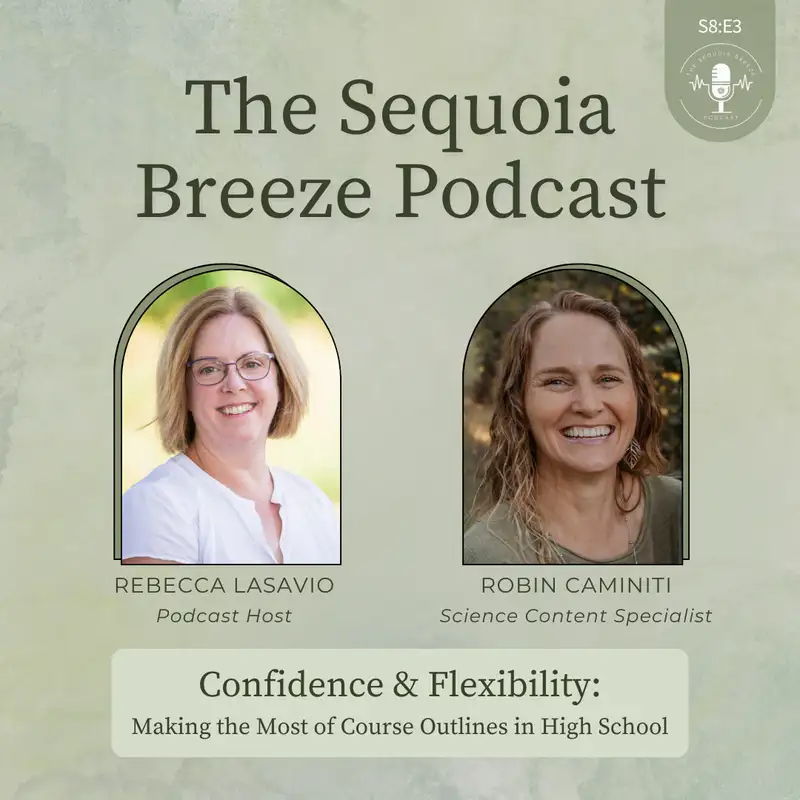
Rebecca: Welcome to the Sequoia Breeze Podcast, a breath of fresh air for your homeschool. I am your host, Rebecca La Savio.
I'm super excited to have Robin Caminiti here today. Did I say your name right?
Robin: Good enough. So.
Rebecca: So if you have a high schooler or will have a high schooler in the next couple of years, this episode is for you. If you are an HST with any high schoolers on your roster, this episode is for you and I.
This is a topic I've really been wanting to do an episode about for quite a while and Robin has put up with me as I've picked her brain and emailed her and called her.
So today we are going to talk about the high school outlines, but I'm getting ahead of myself, so let's, so let's back up. Hi, Robin. Welcome.
Robin: Thank you. Thanks for having me.
Rebecca: So tell us a little bit about yourself.
Robin: Well, I am super glad to be here and be part of this team.
I am a mom of four kids who are mostly grown.
I have plethora of different things in my background.
I started out as a public school teacher. I taught at Rockland High School. I taught science.
And once I got pregnant with my first, I decided that I wanted to stay home.
I had a friend tell me about homeschooling. I really had very little knowledge about it.
And I became an HST for Horizon.
As I was working with the families that I was working with, I just loved what they were doing and how they were influencing their,
their kids and their lives. And I, by the time my daughter was 4, I was, I was hooked.
And I knew, I thought if I can teach science, I can, I think I can do this. A little afraid I wasn't going to be able to teach my kids how to read because high school science is different than teaching somebody how to read.
But I did it and yeah, so I schooled my own kids. I was a HST for 13 years for Horizon. I taught a lot in their co op. I taught all the way from elementary school to high school sciences.
All, all of them.
And 13 years in, I decided that it was, I had too much on my plate. So I stopped doing that for a while and just did the homeschool co op teaching.
I also have taught for Veritas Scholars Academy online all over the world.
Was a very,
an amazing job.
And recently I've been brought in, into this, into this role and so I've had a lot of different types of experience. I've been a homeschool mom.
I've Been a teacher. I've been a. Yeah, I've done it all. So now I'm getting to use all of those things in this new position.
Rebecca: So tell us, what is this position called?
Robin: So my role is called the Science content specialist.
Rebecca: And what does that mean?
Robin: It means that I'm here to help teachers and parents and students in high school courses having to do with science.
Rebecca: So this is Robin's job is cool in that she is accessible to parents, not just to teachers or staff. And so we're going to talk more about that later.
But the content specialist is kind of a new role within our schools. Yes. Okay. And so currently there's you doing science.
We have a great gal named Arpi Osepian, who is also the content specialist for English.
So we're building a group that is a solid resource for parents who are working through these subjects with high schoolers.
Robin, why don't you tell us what the course outlines are and why we might need them?
Robin: Okay.
So a way for our schools to make our state standards and to be able to have the flexibility that they want to use any curriculum that they want that they choose is the reason why outlines were designed, which is so unique in.
In our. In our state and society.
Um, but it's beautiful. But in order for us to meet compliance and meet the standards that our state requires,
we have this backbone that we need.
And so that is kind of the basis of what an outline is. There are many curriculums that we actually don't need to use the outline, but if you want to do something different,
then you use those.
Rebecca: And using the outline allows us to be A to G.
Yes.
Okay. So if you don't know what A to G is at this point, I'm going to let you talk to your HST about that, because it's a whole different conversation.
So some curriculum is already A to G. Like if you used a Mr. D math for your algebra class, you don't need an outline because that's already been approved by the UC system as being A to G.
Our virtual academies are A to G. But if you want to use a Saxon math, or if you want to use IW for English or something like that, they are not approved A to G curriculums.
But by modifying a little bit and using our outlines, that creates this backbone that is already A to G approved.
Robin: Yes.
Rebecca: And that's correct. Okay.
Robin: Yeah.
Rebecca: Good job.
So I invited you here today, Robin, because I personally have wrestled with the outlines,
and I know that the outlines are there to set me free and allow Me to use the curriculum that I want to use with my kiddos. But sometimes as the parent, I have found them a little bit hard to understand.
And I know that HSTs also appreciate a resource to help get our heads around being consistent in our usage of the outlines. So why don't you talk?
We kind of covered this, but maybe you could say it a little more succinctly. Why would a family want to use an outline or when would they need to use one?
Robin: Okay,
well, so when a family would need to use one is when they are not using an A to G approved curriculum. Okay. So anything kind of outside the box of that a family would want to use an outline anytime that they're looking for additional resources.
So this year, many of the outlines have been updated by our content specialists, people who have homeschoolers in mind.
And they are just. They should be a great resource for you. So if you are doing your curriculum what the. Whatever curriculum that you choose, and you look at your unit and your unit maybe doesn't have a good lab or very good assignments, or you maybe you want to add just a really neat project,
you could go to the course outline and find that.
That being said, even if you were doing an A to G course and you wanted some great supplemental assignments or labs, they're there for anyone to use.
Rebecca: Oh, you mentioned that they've been rewritten this year. So if you've used an outline in the past and you still have that, like, downloaded on your computer, you should go get the updated.
Robin: Yes.
Rebecca: Version. Because pretty much all of them have been rewritten, haven't they? Well, close to it.
Robin: Well, all of the. Not all of. Almost all of the science ones and the English ones definitely have.
Rebecca: And several of the history, too. I've seen a difference.
Robin: Yes. Well, we put a facelift on all of them.
Rebecca: Okay.
Robin: That doesn't mean that all of the assignments have been modified, but the science and English are definitely new.
Rebecca: Okay. And I've noticed a lot more streamlining of how they're laid out. Like, history used to have 12 units. English had four. Now everything has eight.
Robin: Yes.
Rebecca: So it matches our LPs, and it makes it a little more consistent across the board.
Robin: Yes.
Rebecca: So.
So if you have old. And I found myself in this position a little bit where I had, like,
world history for my older daughter downloaded in my computer. Now it looks a little different as I'm working with my second daughter. And so I needed to make sure I was using the current version.
So.
Robin: And the current version, not only is it our Current version, but it also is aligned for HSTs in school pathways as your AWRS, so you should see that it lines up directly with those.
It's also been submitted for AG approval in the same verbiage that you actually see in the new documents.
Rebecca: Okay, so for hsts, it's a little more streamlined to match it up in the back.
Robin: Yes.
Rebecca: And for parents, it just lines up more closely with our LPs and makes it a little simpler to figure out. Exactly. Okay.
Robin: Yeah.
Rebecca: Can you explain to us how a family would approach using the outlines?
Robin: So a family would find their curriculum of choice,
and then you could either use us to help you align the outline to your curriculum,
or you could yourself where if you went through and you saw the units that was in your curriculum and then you, you saw the possibilities of the key assignments,
you could pick one, or you could use a key assignment like from your curriculum.
Where you would really need to use the outline would be that if you picked a curriculum and a. An entire unit is not being met in your curriculum, then you would go and you would do a key assignment from that unit on the.
On the course outline.
Rebecca: And that helps ensure that the standards that our school has agreed to with the state are being met. Correct. And that when they put down that a student has done this course,
the colleges they're applying to know it's an. It's an equivalent.
Robin: Yes, yes.
Rebecca: So while each of our kiddos gets to learn the content in their own way, maybe focus on certain parts more deeply than others,
there is a.
There's a consistency that is brought by using the outline.
Robin: Exactly. I'll give you an example.
So we've been doing these course alignments that align your curriculum with the.
The outline itself.
And I was going through one biology curriculum and they didn't do parts of the cell.
And it made me wonder, but nonetheless, like, so somebody who was using that curriculum would need to go to the cell unit in biology and do a key assignment about the, you know, cell structure and function.
Rebecca: So go to the library and get a book about that, watch some YouTube videos, build a cell, do something that like.
Robin: Or just pick one of the key ass that that should. Should make sure that you have covered that content.
Rebecca: Okay. Let's talk a little bit about how course outlines are laid out.
Robin: At the beginning of each course outline is a description of the course and suggestions on how you might want to grade it. But it also has some really neat components this year at the top of them.
It's great resources for that subject.
So we have Like a resource for biology example. And if you click on it, it leads you to just a.
Like all of my favorites when it comes to biology and video content and some curriculum, but where you find labs and online interactives and all of those kinds of things.
So that's a. That would be something that, even if you're not using a course outline, you might want to go look at that because it's like. It's like the best of the best.
And there's also a place to click to tell us if something is not right in the course outline so that we can have immediate feedback to fix those things.
There's also a place to submit key assignment work samples for the.
For us to be able to collect student samples to show to families to show. This is what this,
this key assignment might be like.
Rebecca: So that link won't turn in their sample for their hst? No, it will, but it's a way to say, hey, look at this cool thing we did. And then you guys can use that as ideas for other people.
Robin: Exactly. Okay. Exactly. We're hoping to build that library.
So that's the beginning. And then when you get into each unit, the units are all set up the same where the.
The standards for that unit has been put, put at the front of the document. It's all got checklists, so you can check them off as you go, which is always satisfying.
It checks them off and crosses it off.
Under that is going to be the key assignments. The key assignments. There's a huge variety there. You'll see that the first one is always going to be that it's an assessment from your curriculum,
which should.
Rebecca: A test or a quiz or something.
Robin: Yes, yes. Something of that nature.
There's also one of the key assignments, and all of them we put in this year is either a job shadow or a field trip. And so you would pick that of your choice, but then have the student do a reflection on it and how it relates to the content of your.
Of your course.
And then the last one is always going to be choose your own adventure. And so a lot of families are checking that box because their curriculum is already providing something of that substantial worth within that unit.
Rebecca: So choose your own adventure, meaning you can do an assignment that's something that's not listed there, but covers that. The same general topic that's being covered for that unit.
Robin: Exactly.
Rebecca: Okay.
Robin: Yeah.
Rebecca: And when they're looking for an approval, an appropriate choose your own adventure assignment, what should they be looking for?
Robin: Yeah, that's a great question, because it's not necessarily just like a worksheet.
If you would compare what you might be looking at to the other key assignments listed in the outline, that would probably be the best way to see the standard. Like the level of work that we're looking for.
It is more of like a little bit bigger project than just a worksheet. It could be a full blown project for the unit, but it's something to bring your, your students learning to like completion, to show it off, to,
to go deeper.
Yeah. So I would say to look at the other key assignments is a good way to see that it's more than a worksheet.
But it doesn't have to be enormous either.
Rebecca: Right. It doesn't have to take three weeks to put together. Exactly. But they also want to be looking at the standards that are there too. Right. So they're kind of trying to hit those standards.
So even if it's with science, it's the subject, is the subject. But sometimes with English, what you're,
you know, you might not be writing the goals of the standards, might be more of a certain type of writing,
but a reflective essay or something. But whatever is what's suggested in the outline.
The topic could be different perhaps,
as long as it's still meeting that standard.
Robin: Correct. And you know, there's a lot of standards sometimes within a unit and you're not trying to meet every single standard in your key assignment. You may just be looking at one and really, you know, diving deep on that one, which is totally fine.
The point is, is that you are, you are looking at the same content that would be asked of the, those standards.
So, and then I want to add, add too that in science because every other science has more. Science also has another component of each unit and that is the labs.
Because there are, every high school lab science has to have 20% of their course B labs. And so we want to encourage that.
So for each unit there's going to be, you have to have a key assignment and a lab. Now of course that lab can be from your own curriculum, but if you want homeschool based really neat labs, they're there for you to choose as well.
Rebecca: So does that mean that there is an expectation of a lab each learning period?
Robin: Yes.
Rebecca: Okay.
Robin: Yeah. And that would be true of any school anywhere.
Rebecca: And is there an expectation of a lab report?
Robin: The, the requirement that we have put on is that one to two lab reports per semester. So not a lab report for every lab. No way. That's way too much.
But,
but, but that's there. Yeah. One or two. And then there's templates there as well for students to use and rubrics.
Rebecca: I forgot to even look there. And I just went searching on my own for templates. Don't do that.
Robin: It's all there.
Rebecca: I'm going to look that up.
Robin: Templates and rubrics are there.
Rebecca: Okay.
Robin: Yes.
Rebecca: And, and rubrics, because that's hard too, to decide how. Another thing that I have sometimes felt and seen confusion over is whether a key assignment has to be used as a sample.
So maybe. I know we're going to write an essay on something that would cover that key assignment topic,
but samples are due today and we haven't done that yet.
So can I turn in something else we've done that meets a standard, but isn't necessarily the key assignment?
Robin: Yes,
the short answer?
You know, when you go and meet with your hst,
you are,
you're,
it's, it's like it should be a time where you get to show off what you have been doing that, that learning period.
And so when you come to that meeting, you should have all kinds of work samples that your, your teacher should be able to look at and see, you know, kind of the scope and sequence of what you've been doing.
And then the, between you and the hst, I mean, and HST determines it at the end, they are going to pick the work sample that best shows off what you've been doing.
Could it be a key assignment from the outline? Absolutely. Could it be something else? Yes, it could. And so,
you know, if you're working on a key assignment that's not going to be done, then,
then obviously that's not going to be your, your work sample for that, for that month.
Rebecca: Not, not because we're behind necessarily, but because the timing of whatever it was we're covering isn't necessarily working.
Robin: Yeah. And there might be something else within your, within your body of work for that body of work that might be a better show off of, of what's been done that month.
Rebecca: Okay, so I want to just pause here for a second and speak to.
These outlines have been written to set us homeschooling parents free to homeschool high school because the state is not set up for that.
Robin: That's a good way to say it.
Rebecca: Yeah. And so this gives us the freedom to be able to do that and not as a school require,
that all of our students take the exact same high school courses.
Robin: Exactly.
Rebecca: Which some of the other charter schools do.
So this can feel like an extra requirement or an extra burden.
But the goal is actually setting us free to be able to do what it is we want to do to meet our family goals through homeschooling.
So as we go along,
I want all of us to keep remembering that. And actually,
I have found Robin to be fantastic at helping me set myself free from getting too tied up in the details.
Robin: So it's a challenge. And, and we've talked about this before, but when I was homeschooling my own kiddos,
I,
I could have.
If this was presented differently,
this could have been a burden. And I probably would have seen it as a burden because it would have seemed like I'm trying to do my very best with the curriculum that I've chose.
And I have to do this on top of.
We can help you look at your curriculum and figure out, you know, a lot of times curriculum will have more than what we are looking for. And so maybe there are pieces that can be taken out to do in exchange for.
But if you look at it, at the end of the day,
you are trying to do what you want to do as a homeschool parent,
but in order to meet the A to G standard, there are things that need to be met as well. And so we're trying to help you find that balance. And,
and in the end, give your child a really great education.
Rebecca: You know, I,
I tend to be one that wants to like, do. Do all of it. And yet some of these homeschool courses, especially science,
well, and some of the history, they can almost be college level. They're so dense, rich. And so being able to,
okay, is this a priority for my kiddo or is this a requirement?
And being able to.
For my kiddo that wants to loves biology and wants to dive deep, let's. Let's do it all. But for the kiddo that it's a requirement,
maybe we can shave a little. And the outlines help us know where and how to shave those things off,
which then gives our kiddos room to flourish in the areas where they want to focus.
Robin: Yes,
well, and it should be able to give them a choice. So if they are just looking at meeting the minimum requirement and you are missing a unit, for example, from your curriculum that is on the course outline,
there should be enough choices there that your student could look through the options and find the one that interests them the most.
And of course, there's the choose your own adventures. So if they wanted to go in a different direction with the same standards, they are welcome to do so. So there is some student choice in there as well.
Rebecca: Do you think that the outline should be a tool the student has access to as well, or just the learning coach.
Robin: I would have, with my own kids, I would have said, you guys, let's look at this. Okay, we need to do one of these because we've got to learn about the cell.
Which one. Which one interests you the most? Yeah, I would. But every student and parent is different, so that's a. That's a family choice.
Rebecca: Okay, so can you talk a little bit more specifically? Maybe even choose a popular curriculum that you could kind of talk about? Like, here's how I would take the curriculum. I would take the course outline and plan the year or the semester or.
Robin: Well, that's one of the things that RB and I have been doing, is that HSTs or parents have been saying, hey, we're using this curriculum. Could you help us align it?
And we would love to help you with that. And some of them have already been made,
and we'd be. We'd love to give it to you.
Rebecca: And that just helps the parent know,
hey. Unit three of the outline matches chapters six, seven, and eight of the curriculum that you're using. So as long as you are covering those chapters, you're covering unit three,
do a good assignment for that key assignment, and. And you're covered.
Maybe I can give this example. So I know three high school kiddos who are using IEW level C this year. 9th grade, 10th grade, and 12th grade. And for 10th and 12th, everything from the outline is covered.
But for 9th grade, there's a poetry unit that isn't covered. So that kiddo needs to make sure that some poetry is covered.
But when ARPI was able to give me a chart of how it all works, I'm able to pass that along to my hst. And we can see. Here's what's being covered as we move through this.
Robin: Exactly.
Rebecca: Okay.
Robin: I would always recommend to a family that you go through the curriculum the way that the curriculum was designed.
But your hst, your poor HST has to figure out how to make that, like, work with the course outline.
Rebecca: So.
Robin: So instead of that having to happen,
you now would have a document that shows. Well, yes, when you meet. When you do,
you know, chapter X, it meets this on the outline. Oh, and we've. We've seen that there is maybe a gap here or there. And in those instances, that's when you would go to the course outline and you would pick a key assignment or a lab to fill that.
Rebecca: So sometimes the outline doesn't go in the same order as the Curriculum.
So you are suggesting let the outline go in the wrong order throughout the year and follow the curriculum as it's written or it could get really confusing.
Robin: Absolutely. You don't want to mess with, I mean,
each author has designed their curriculum on purpose the way that it's designed.
So you would follow your curriculum and then it, you know, match it up as you, as you go through the outline.
Rebecca: Okay, so what are some of the pros and cons of following a course outline?
Robin: Yeah. Okay, so let's do cons first.
They can be intimidating, right. If you don't know how to use it in the freedom sense,
if you're using it more in, in the way that this is everything we have to do on top of our curriculum, that, that can be really intimidating and overwhelming. And they are long.
They are long not to drive you crazy, but just to provide lots of options for you.
So I think that's the major con.
Rebecca: And I want to make sure you just said if we have to do this on top of our curriculum, which. That's not the point.
Robin: That is not the point.
Rebecca: That is not how they are meant.
Robin: To be the point.
However, I would say that there are some curriculum out there that are really basic and not ones that I would necessarily recommend. But there are times that those things need to be used in kids lives.
Whether you know they're having a hard time or it's a difficult subject.
In those cases you may do the bare minimum curricula and do a key assignment every month to boost it.
So that would might be an option,
but not the normal. Not the normal.
I don't know. Can you think of any other cons coming from, from as a parent?
Rebecca: Well, yes.
So I have one kiddo who does not like online classes and so she has chosen to do every single one of her subjects aside from Mr. D math.
They are all course outlines. And that's a lot more work for me than if she wanted to do HSVA or something else like that.
So it takes a lot of time and it's not the course outline's fault. This is the implication of we're choosing a course outline is that you are a hundred percent homeschooling this subject.
And so now that means the pacing, the correcting, the assigning, the collecting,
all of that is on me.
So that is something I want to do.
But that's definitely kind of the con side of it's. It's fairly intense and it's easy sometimes when you're sort of homeschooling through life and life is happening.
Sometimes you can think,
oh,
we've been doing really good stuff, but it hasn't been history.
Yeah. So.
So all of a sudden now it's up to me to make sure, are we getting the meat that we need to be getting? And if we're behind, how do we catch up?
And so it's a lot of work.
Now having the outlines allows me to be able to do that, to choose those curriculum that I really like and it does give the flexibility to do those other things that are worthwhile.
Whereas when we were doing HSVA classes, I sometimes felt like we didn't have flexibility because they had to be in their seats at certain times and those assignments were due when they were due, regardless of whatever else was going on in our life.
And so I can look at them and say, okay,
you have theater for a solid week here. I'm going to try to give you a little extra leading up to it so that you can have a break from other subjects and focus on that.
Whereas if you're in an online class, you don't have that kind of control.
Robin: So I honestly think this is a side note, but if you had alignment documents for your courses,
you would find it a lot less intimidating because then you would know which pieces of the outline I actually need to pay attention to and which ones I can just ignore altogether because then it turns a 30 page document into a, maybe a three page document and it says,
meets the standard, meets this, meets this. Oh, you, this is one you need to look at. Meets it, Meets it, meets it. Oh, you need to look at this. And that's.
Then you just do your curriculum.
Does that make sense? Yeah.
Rebecca: Yeah.
Robin: So I think it changes the way that you would look at it because it's not like I have to do this huge outline. Instead I need to do my curriculum. And these two, three areas are where I need to, to do.
To do something awesome off of the outline.
Rebecca: I think what my point was that when you do the outline, you don't have another teacher who's keeping track of your kiddo. It's you. Which is why you chose homeschooling.
Yeah,
but it's a bigger job when they're in high school than when they're in second grade.
So does that.
Robin: Yes.
Rebecca: Make sense? So it's the, the con is also the pro.
Robin: Yes, absolutely. Absolutely. But on that note too, I mean, that is why we are here to help you.
Rebecca: Yes.
Robin: And so although I'm not going to grade every science high school,
you know, key assignment, I am here like if you want to show me your students lab report and get some tips or if there is something technical that you need help with,
that's what we're here for as well.
Rebecca: Yeah, that's a great point because I know that that was with my older daughter. I put her, kind of gave her a tutor for labs because I'm like, I don't really know how to do.
Yeah. And with my younger one, I'm like, okay, here's a,
here's a lab report now. Right. But I don't know how to give her good tips on, you know, they wanted to squish some of the categories together and was like, I don't know if you're supposed to do that.
Robin: Well, some of those things are hard. As a parent and a teacher at the same time, I. Yeah.
Collecting works and giving back to your own student. You're sitting right there. You normally talk to them about it. Yeah.
Rebecca: Yeah.
Robin: So to have an outside source. We're available for that.
Rebecca: We will talk about how to contact you. Yeah. Before we're done. Okay. So pros.
Robin: Yes.
Well, I just out the gates. One of the pros that I want to mention and make sure that everybody knows is that we now have honors courses available in chemistry and biology and the Englishes 10, 11, 12.
And so that means that if you are doing an outstanding curriculum that is more than the gen Ed,
you now have the ability to get it pre approved by one of. One of us, the content specialist and then can get honors credit for that course.
Rebecca: So that's fantastic. That's a new thing.
Robin: That is new. It's brand new. Yeah.
Yeah. And we do. We have a handful of students doing it in science and a handful of students doing it in English and hopefully we'll see that grow as.
Rebecca: And when a student does an honors course, it has a bump in gpa. Correct?
Robin: Correct. Okay.
Rebecca: It's not an ap, so they aren't getting college credit but they are getting acknowledgement on their GPA that this was a harder course than.
Robin: And acknowledgement on your transcript that it's an honors level course.
Rebecca: Okay.
Robin: Yeah. So that's exciting.
Yeah. And one of the ways that you can do honors level in chemistry and biology is by doing the science fair route.
And so we've got some kids doing that, which we're excited about.
So. Through the Sacramento STEM Fair.
Rebecca: Oh, cool.
Robin: Yeah. Little plug there.
Rebecca: But is it this year? 25, 26. It's too late to switch to honors at this point.
Robin: Yes.
Rebecca: But you can plan ahead.
Robin: Yeah. I don't Know if you could do it second semester? I need to find that out.
Rebecca: Okay.
Robin: Yeah.
Rebecca: But you can definitely be planning ahead for next year or for future kiddos.
Robin: Yes.
Rebecca: Okay.
Robin: Yes.
Other, other pros.
There's some really fun, creative projects that are available for you guys,
at least in science. Like, I've. I've taken the things that I've done over the past 20 years and knowing what it's like to do science at home,
have geared these labs and assignments for. For the homeschooler. And so there's a lot of. There's a lot of great content out there on the Internet, you know, in books or whatever.
But these have been written with you in mind and so.
Rebecca: And your years of experience homeschooling.
Robin: Yeah, well, you know, and I just know what it's like to have glassware versus using GL plastic cups. You know, like, those things, you know, you don't think about until you're sitting there and you have 10,000 supplies and you actually only need four of them, and you could have used this instead of that.
And so those things, a lot of thought has gone in to those.
Yeah.
Rebecca: I think the biggest pro is that it does allow you to homeschool high school.
Your family has goals in how and why you are educating your kiddos. And so being able to choose your curriculum and choose your method allows you to then meet those goals.
By having these outlines, you are able to continue doing that instead of simply taking a class that the school says you have to take. And it doesn't get to meet your family or your kiddo where they're at.
Robin: Yeah, it does.
It provides the route for you to be able to school your child the way that you want to school your child and still meet that A to J requirement.
The other thing that is, I think, really beneficial, I remember thinking, like,
is the quality of work that we're doing the same standard as other students in California.
And I think that. That these assignments and labs will help, you know, the level at which a high schooler should be doing their work.
I remember when I was in hst,
I really struggled with this when it came to English because I just didn't have a standard to compare my. My high school English students to.
To know, like, hey, this is. Yes, this is the quality of work we're looking for versus, no, this is. This is not where we should be.
So I think it also helps define the standard at which these courses should be done at.
Rebecca: So it takes some of the guesswork out of, like, is this enough? Yeah, that we Homeschool moms can kind of rack ourselves with sometimes.
Robin: Yeah,
for sure. You know, like my son right now is bringing home his chemistry work and I'm like, yes, this is the same thing that we're doing.
You know, it's the same level.
So that's, that's there. I think, I think as a, as a mom, I was always questioning, like, is this, is this enough? Is this the same standards?
Rebecca: So let's talk for a minute about lining up the outline with the curriculum. For example,
in history,
the curriculum that I choose tends to go back further and a little more detailed than what the outline requires. So sometimes it might take the first several chapters that it's sort of setting things up or getting to the point where the course outline starts.
So if I were to line up the curriculum with the outline, we will cover all of the topics that are mentioned in the units of the outline.
But maybe six of the eight are in the second semester and only the first two,
in one case, I think it was even one, are covered in the first semester.
So it's really off balanced with the outline. Does that mean that I have to cut out a bunch of the content of the curriculum in the first semester that I've chosen?
Yeah.
Robin: So this is a tricky one.
And you are going to find, just like in any school, that there's going to be some variation from teacher to teacher on this.
Rebecca: Is that okay if there's variation from teacher to teacher, or should they all be asking for the exact same thing?
Robin: It has to be okay. We're all individuals, we're all teachers. We all have our bents, we all have our strength.
Rebecca: And at this point, when we say teacher, we're meaning hst.
Robin: Yes, yes. H. Well, and parents too. But, but yeah, I, I think, I think that there has to be some flexibility.
But in the course of the year,
the content from the course outline,
the standards, needs to be covered. So I think that's tricky. I mean, there might be an HST who, who's okay with it? The problem is, is that we all know that HSTs have to go do AWRS at the end of each learning period.
And if there's nothing for them to click off, that makes it really challenging.
So I think what I would suggest, and this is just a suggestion, is that, yes, you do your curriculum because that's what you've chosen, but maybe you figure out how to do key assignment from one of the units,
even if that means you're jumping ahead a little bit so that the,
so that the HST has a way to report that you actually are on your way to meeting these requirements.
Rebecca: Because obviously if six of the units are in the second semester, it's going to kind of go through them a little faster than what the outline is suggesting. So maybe if you can plan ahead and see, you know, we're going to cover three in this learning period.
We would cover two different topics. One of those we'll just cover then, but one we could do a quick little assignment for now so that we're covering that in a more steady way.
Does that make sense?
Robin: Yeah, I mean, like the idea would be is that you would do four units in first semester and four units in the second semester. So if you're going to do six in this second semester, maybe those two that are, you know, at the beginning are something that you could flip flop.
Rebecca: And.
Robin: And I know that's where it gets a little tricky because then you're feeling like I'm not doing exactly what I want to be doing. However,
you're also trying to meet those A to G standards.
Rebecca: Well, okay, so to be specific so that we can make this make sense for world history,
it has one,
one unit talks about sort of leading up to what developing Western Thought Unit 2 jumps to the Renaissance.
So if our curriculum doesn't hit the Renaissance until,
you know, a ways up, because it's covering all of that ancient stuff in more detail,
perhaps I can do a renaissance assignment in LP 2 or 3.
And then.
Because that doesn't hurt anything and it's still going to cover what we're going to be talking about.
Robin: Yeah. And further talking about high school students as well. So you can explain what you're doing.
Rebecca: Right.
Robin: This is where, this is where history's heading.
Rebecca: Yeah.
Robin: So we're gonna get a little foretaste of what all this, all this ancient history is leading up to.
Rebecca: Well, and if in English you're talking about Shakespeare, you can have a little overlap. Because I think that's the other thing we forget is sometimes we can look across disciplines and if there's something you're doing, if there's some history of science thing that you are covering at the same time that you're,
you know, this discovery was made at the same time period as this history thing that you need to do, you can do a little bit of overlap.
Robin: Yeah.
Rebecca: It doesn't always have to be something completely different. Yeah, that makes sense. Yeah.
Robin: I think I just get creative.
Rebecca: Yeah.
Robin: In like trying to take one thing.
Rebecca: I've learned of four years now of learn of using outlines is that one attitude is everything.
So I can resent filling in the holes or doing things in a certain order,
or I can recognize that there's some really cool people that have written this stuff and that doing these assignments is a bonus to my kiddo, or doing them in a certain way and not forgetting that all of the.
All of the good things that we're getting from the school as well, you know? And so I can. I can look at it that way,
or I can be irritated, and I can transmit that to my kiddos. And then it's.
Yeah, the learning is shooting us in the foot, like, we're doing the opposite of learning at that point.
Robin: It's so true. Attitude is everything. And perspective is as well. Like,
you can absolutely be a private homeschooler and do it however you please,
and you are welcome to do that if that's the direction that you want to go.
However, if you want all the benefits of our community and of our school and all of the resources and all of those things,
then there are times when you need to do it within the boundaries that.
Rebecca: That we have set, which are not for our harm.
Those boundaries are there to help our kiddos,
if they're headed to college, have the right things on their transcript and make sure that there aren't, like, we're all gonna have holes in our education, but that there aren't, like, really significant ones.
Robin: Exactly. You know? Exactly.
Rebecca: The other thing that I have learned about using outlines is that planning is key.
Because if I can sit down,
even if it's like a month at a time, and look at, where are we going? What does the outline need?
It can help me realize when we do this chapter,
this would be a fantastic sample, or this really meets the requirement of the outline. Well, but if I'm on the fly, I haven't thought it through, then it can be hard to have the sample ready at the right time or.
Robin: Can I back you up just a second?
I would love for you guys to be able to not be thinking about, this is the sample that I need to give my teacher, but this is the education that I want to give my child.
Because I think it changes the way that you think about what it is. Like, it's. It's one thing to check off a box, because you have to,
and it's another thing to look into the assignment and say, what can my child learn and gain from this?
And I think it changes what the assignment is. No matter what assignment you're looking at, whether it's from your curriculum or if it's from the outline.
Because in the end, like, that's what we want. Right. We want kids who grow into adults who have just a great foundational education.
And so if you stop thinking about what has to be done, I even think of it with grades. I hate grades.
I'm very untraditional in the way that I suggest grading,
because I care way more about a student learning and understanding than I do about checking off the box.
I know it's hard.
Rebecca: No, no, it was. That was beautiful. I'm gonna be thinking about that for a while. But now take me to practical.
Robin: Yeah.
Rebecca: Like, okay, so I'm not focusing on the samples, but they're as. We're recording this. They're due today. Yeah.
Robin: So that goes back to why planning is so important.
Right. So again, I'm just gonna use the biology example.
If my book. I don't know. I love kids being able to make a model of the cell. I just think it's. It's tangible. The. The models that I've had my kids make over the years, they actually still have them because we did them out of Paris of plaster and sculpey.
And I just think, you know, if you're going through the cell unit and use.
You can go to the outline and see that it's there and how to. How to actually do it.
And then you have this.
This learning tool for the rest of their high school, college, you know, they can't even use it. Remember the model, you know, and they have it on their counter.
It's just the difference between doing it because we have to do the stupid model versus, like, we get to do this, and we have a really neat end product from it.
And I think you can do it. It doesn't just have to be the cell model. It can be all kinds of things.
Rebecca: When. When my girls were little, we did. We did a cell model in Jell O.
Robin: The problem with that is you eat it and it doesn't last.
Rebecca: It was quite an experience. But they also were supposed to make cookies and decorate them with the periodic table of the elements. It was so many cookies.
Robin: Yeah. I'm not sure that that's a great learning experience. There are lots of great projects, but not all projects are great learning experiences.
Rebecca: But now my. My now sophomore in biology is like.
Robin: Can we do the cookie thing? Ye.
Rebecca: She doesn't remember the elements, but she remembers making the cookies.
Robin: But. But think about that. I mean, she remembers,
right? And how many assignments does she not remember?
And so if you are wanting to give your child Just a great education.
Those experiences and the assignments that are going to last in their memories are going to be the ones that are substantial. And so that's what a key assignment is. A key assignment is something beautiful from what you've just learned,
but taking it farther and deeper, not just being in the textbook or online or whatever it may be.
Rebecca: Okay, so so much of what you've said today shows us what a fantastic resource you are. And you've told us that you are.
Your goal and your job is to be available to hsts and to learning coaches who need to talk through some of this, work through some of it, get some ideas, pair down,
figure out where to focus or where to go deep.
How.
How do people find you find arpy. What if they have a history question and we don't have a history coordinator yet?
Talk to us a little bit about how they can go about getting that help.
Robin: Yeah, I think the very best way to contact us is through email.
And then at the bottom of our email, you'll see that there is a button that says schedule meeting.
So if you wanted to talk to us on zoom, face to face, we are. We are happy to do that as well. But email is a great way to start just to connect with us to know what your need is and to see how we can help you.
Rebecca: Okay, so neither of your last names are Smith. So both of those emails will be in show notes so that.
So that parents can find you.
And so would they go to you if they have a math question?
Robin: I can answer some math questions, but not all of them.
Rebecca: But you can help sort of sort through an outline.
Robin: Yeah, absolutely. Yeah. I would say we are working on getting a math content specialist, and that's definitely a need. But Linda's also a great resource.
Rebecca: Math.
Robin: She's. She's a math person. But.
Rebecca: So they could start with you and rp and if you guys don't know the answers, you'll help reach out to Linda, or Linda Chen is the high school director who has been.
Had her. Her. She's been elbow deep in these outlines. In fact, I believe they were her. Her brainchild.
Robin: Amazing what she's done.
Rebecca: She has created these outlines so that we can continue to homeschool high school and has made that possible. And so now they are kind of. Her baby is growing.
Robin: Yeah.
Rebecca: So. So she is also, you know, a great source and advocate for all of this.
Robin: So, yeah, I think in general I'm happy to help with other outlines besides science. Just with my own homeschooling knowledge. Doesn't mean, I'm going to know everything that you're going to ask me, but I'm.
I certainly can point you in the right direction.
Rebecca: And you're familiar with a lot of homeschool curriculum, so you'll know what they're talking about. And yeah, you might, you might know strengths and weaknesses, some of them pretty quick because there's plenty that you used.
Robin: Yeah.
Yes. But we are available for you guys.
So we've had parents reach out. We've had a lot of HSTs reach out.
Please do like if you're struggling with the content of an outline or how to do it or what to please reach out.
Rebecca: So if you're an HST who has a family using an outline and you don't know which AWR is to check for that, what the work that they did that time, they can contact you and you guys can work through some.
Robin: They can contact us having to do anything with an outline.
Rebecca: Okay.
Robin: Yeah.
Rebecca: I know some great HSTs that are trying so hard to figure this out and they're trying to line the outline and the curriculum up themselves.
But you guys have already done that for several different curriculum, correct?
Robin: We have done that.
Rebecca: So they can reach out.
Robin: Now, there's like 10,000 options out there. We have not done 10,000 of them,
but we also have a way to like that. We have a template so that we can take.
Rebecca: We.
Robin: If you need help with an alignment. What we do need from you, and this can be apparent as well, is we need, we need the table of contents from that curriculum or a website that will take us to it so that we can.
We have to know what's in it to be able to align it.
Rebecca: Are there any other changes that we should be aware of in the updates of the outlines? You know, a parent who's never used them before would probably go through, but a parent who has used them before might miss a few things if there are important changes.
Robin: Yeah.
One of the big changes that actually shouldn't have been a change, but it just wasn't on them before was is that there is some sort of final that needs to be done in for each course outline.
Now,
don't freak out because we have lots of really neat options for you. And it, it could be any assortment of things. It could be a compilation of your work throughout the entire school year.
And just, just in a portfolio, we have added to, to our options that you could do a show, you could do a showcase event, which is really fun. And those have been growing over the last few years.
Rebecca: So maybe Do a display of what you've learned that year that you then take to the showcase.
Robin: A display, a presentation.
Maybe you've made something that you can sell even from that you learned from that class.
Any of those things would work. You could also do an assessment like. Like normal. You could do a project, you could do research. You could.
There's just anything.
Rebecca: Anything.
Robin: And you know what? As a teacher, like,
I've done all different kinds of finals over the course of the year, but I've found that, like, the final is so essential in reviewing the content of the year. And students take away so much more when they take the time, even if it's just for a day, to reflect on what.
How much they've learned. And so at times I've said we're having a final, but then the kids show up to class and we end up just doing the final with a partner.
And it's not even graded, but it's just so that they can review and remember all that they've learned throughout the course of the year.
Rebecca: So the point of the final is something that is review or compilation or using the knowledge that they've gathered to do something. The. The goal is not like.
Robin: The goal is to learn.
Rebecca: The goal is not to always. Yeah. Not to pin them against the wall.
Robin: Yes. I think it should be some kind of celebration of what you've done that year, how far they've come, what they now know because they've taken this course.
Again, perspective changes everything.
It's not. Shouldn't be,
you know, some big hammer test.
Rebecca: So the final could. I mean, there's an element of that that could be being worked on now. So you could be,
you know, as you're learning now, you're adding that to a portfolio or you're adding that to a timeline, or you're. And then at the end, you can kind of bring it all together and.
Robin: Yes. You know, and all of those options are there for you to use on the. On the course outline itself.
So there's a. There is a portfolio option,
and it shows you. So it. It would be the portfolio, but you also do a reflection of the portfolio. It's not.
Rebecca: Okay.
Robin: Yeah. So it. Again, it's there to help your student learn.
Rebecca: And the portfolio could be a PowerPoint presentation or something like. It doesn't have to be. Okay.
Robin: Yeah.
Rebecca: Doesn't have to be Scrapbooked guy's the limit.
Robin: No, I mean, maybe people want to do that. I don't.
Rebecca: Is there anything else about outlines that you would like to say before we Go.
Robin: I wish I would have had the resources that are in the course outline when I was. When I was teaching my own kids.
And I think that if I knew that there were people who have had experience and who have done this and the assignments were written by them for them,
that I would have looked at them more carefully myself and I would have been excited to use them.
Actually, a handful of the ones in the science are ones that I've actually done myself, and I know that they work, and I know that they're exciting or that they're fun or there's something really,
really great to be learned from them.
So I.
I would have liked to have used the. The assignments,
and I don't want them to be a burden. Our intent is not for them to burden you down, but to hopefully set you free and that you don't have to make up the activity yourself,
but it's there for you.
Rebecca: And I think, too,
every time I start to feel kind of frustrated or I can't quite figure out what I want to do next or what I should do next,
it's always helpful to remember because I have this.
I can homeschool my kiddos through high school. Within the charter context,
I think that the tool that we have is really pretty unique.
Robin: Oh, it is.
Rebecca: It's. Other schools don't have this.
And so that is thanks to Linda and the creativity of our Sequoia Grove family and the willingness to do the hard work to figure out how to make this work.
Robin: Yeah, I mean, I. I worked on redoing the physical science outline last year, and it took me like four months. Like a law. A lot of thought goes into it.
And I would say one more thing. If you are looking through the outline and you know that we need to do a key assignment from here, and you don't know what to pick, or it all looks foreign.
Like, shoot us an email. We'll. We'll pick one for you. You know, that you might really like this.
We're happy to help in that way as well.
Rebecca: And this goes a little bit back to the pros. And I meant to say it then, and I forgot, but this is the other really good thing about this tool, is that a lot of parents are overwhelmed by homeschooling high school because it does start to get specialized and it does start to get into,
for some parents, bad memories of certain classes and things. And so this resource means you're not alone. You don't have to completely relearn biology or chemistry. That's my bad high school memory oh.
Robin: No, it should be your best.
Rebecca: And. And it's still possible to do this thing. It is still possible to be a support to your kiddo as they are learning.
Robin: Yes.
Rebecca: And not feel completely out to sea.
Robin: Yeah.
Rebecca: On your own.
Robin: So, and going back to a specific curriculum, I have a family who is using a physics curriculum that is outside the box and they need some structure and so I am going to help them use Khan Academy and Gizmos and the course outline and theirs and kind of put it all together so that then they can just run through what,
what they need to do to get, get all the nuts and bolts towards the end.
Rebecca: So the message Here is families, HSTs, don't be afraid to contact our content specialists because they're fantastic and so helpful and they work really hard.
Robin: It's what we're here accessible. We want to help you. It like the joy of our job when we actually get to talk to parents and to HSTs and like we can actually help them.
Rebecca: And my conversations with RP have shown her to be like, she's so creative. She loves, she loves assignments that are.
Robin: Outside of the box.
Rebecca: So find their emails in our show notes so that you can contact them and they are happy to help. And don't be afraid to use our school outlines because they really are fantastic resource.
Robin: Thank you for having me. Thank you.
Rebecca: Thank you for joining Robin and I today as we talked all about the high school course outlines. I've been your host, Rebecca La Savio. I hope that today's episode of the Sequoia Breeze has been a breath of fresh air for your homeschool.
Please don't forget to share this to leave us a review and to hit like wherever you listen to podcasts.
See you next month.