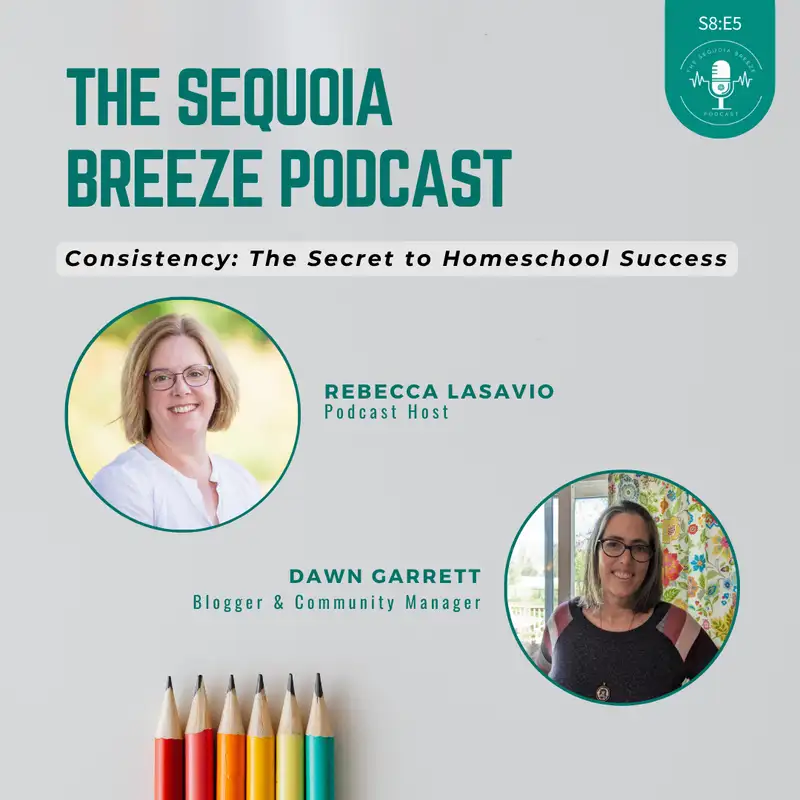
Rebecca: Welcome to the Sequoia Breeze Podcast, a breath of fresh air for your homeschool. I am your host, Rebecca La Savio,
and I'm happy that you have chosen to join us today.
Welcome, listeners. Today we are going to talk about the most important part of homeschool. And it's not the curriculum.
It's not the beautiful schoolroom you created or wish that you had.
It's consistency.
And if you just got a knot in your stomach, please stay with us. By the end of this episode, I hope that you will feel a deep release of mama guilt or grandparent guilt or teacher guilt,
and will face tomorrow with a fresh new motivation that lasts past lunchtime.
So to tackle this tricky topic, I pulled in somebody much more knowledgeable than I. I've invited Dawn Garrett to join me today. So welcome. Dawn.
Dawn: Hi. Thanks for having me.
Rebecca: Go ahead and tell us a little bit about yourself and help us understand why you're gonna know what you're talking about.
Dawn: Okay.
I have been married to my husband Jason since 2000. We have three kids who we homeschooled all the way through with some outsourcing and some dual enrollment at the end.
But they graduated from my home school, all three of them. My oldest is in college in Tennessee. My second finished his associate's degree the year out of after he graduated from high school and has a big grownup job.
And my youngest graduated this past summer. They graduated year after year after year. Boom, boom, boom.
And she is a full time nanny.
So we,
we homeschooled, like I said, all the way through.
And during that time, I was able to work for Pam Barnhill with the Homeschool Better Together community. I'm the community manager there and I do a lot of customer service.
But one of the big things that we do is the homeschool consistency boot camp.
And it's actually going to be changing in 2026. And I know this podcast is coming out in 2026, but we still are going to have a focus on consistency because it is key to every homeschooler.
Every homeschooler can succeed with what they're doing if they are consistent doing the work.
Rebecca: So when your youngest graduate, did you have your own graduation party? You graduated from schooling?
Dawn: Exactly. Not exactly. Although some friends and I did go to the beach in August, so we. I called that my retirement party.
Rebecca: There you go.
That's it.
You can have a retirement party.
That's awesome.
So you've spent many years being a homeschooler and working with,
I assume, hundreds, if not Thousands of other homeschoolers through the Ham Barn Hill Ventures.
And have you seen consistency to be a common problem or worry?
Dawn: Yeah. Yeah. Because it's really easy to not do school.
That sounds terrible,
but it's true. I mean,
that there are, you know,
there are all these people who say, oh, you're not doing anything. Can you come do this for me? Can you help with this? Can you come work with this, you know,
really good cause or supportive family or, you know,
your organizations that you're involved with, with, they think that you're now free labor, volunteer labor. Right.
And so that's a problem.
That's not even the hardest part about consistency.
I know we all have this beautiful fantasy in our heads of us sitting by the fireplace while the kids do handicrafts and mom reads aloud and everybody has hot cocoa and school doesn't look like that.
And so when you just don't feel like it, when your kids are pushing back on, do we have to do school today?
When they're playing so nicely together and you're like, oh, I don't want to disrupt that,
it's really easy to say,
oh,
maybe we'll just do school tomorrow. And then all of a sudden tomorrow is Thursday and you're like, well,
we haven't started yet. We'll start on Monday. Well, we will get started on Monday.
And so I think, I think the,
the struggle with consistency is often inside our own heads and our own, like, families and interactions.
Rebecca: Why don't you define what we think consistency is in homeschool? Is consistency doing every single subject, every single day? Is it working from certain hours to other hours? Like, what are we,
what are we aiming for when we talk about consistency?
Dawn: I think we're aiming for sometimes different things at different ages.
What we ultimately are aiming for is, you know, adult children who go out and do adult things, grown up things once they graduate. So how do we get to that point with our youngest kiddos?
A lot of the times it's just making sure that they think they've done school that day.
So it doesn't even take a whole lot of time.
Right.
But just so they think, oh, school, this is just what we do as a family.
You are on their agenda.
And so they, they're going to wake up with an agenda. They may not know exactly what it is, but it's going to be playing Legos or playing outside or watching this show or doing these things and you are interrupting their agenda.
So it's your job as the homeschooler to make sure. That you are a part of their agenda for the day.
That's consistency with your, you know, early elementary school kids,
it's going to get a little bit more and more as they get older.
When you're in high school, you do have to kind of like make sure you're getting all the hours to get the credit for that class, to put on a transcript eventually.
So by starting where they understand that we did school today,
we do school every day.
That can build to getting enough school hours done in high school to get those high school credits, to put them on a transcript, to send to a college or to a career center or to, you know, an apprenticeship, whatever, whoever is seeking that information.
So the youngest ones, it's a little bit the older ones,
it may not be everything every day in high school, but it's going to be a lot of things every day in high school.
Rebecca: So somewhere in the middle is somewhere in the middle of all of that you're working, building yourself up.
Dawn: Yeah. And slowly building skills and making that learning desirable. I mean some of consistency is.
And getting on the kids agenda is that they kind of want to do stuff because they know that they will know more like that it's building that desire for learning and for knowledge and for information and ideas.
And so.
Rebecca: Yeah. And consistency is probably most important for the subjects that they struggle with. Right. One, because you can't learn to read if you only dabble at it once a week. And two, because if they don't want to do it and they manage to avoid it,
then they're going to just, they're going to learn that they can't avoid it and they're going to fight you every day.
Dawn: Right. And I mean there are, there I would say.
So we make a distinction between skill subjects and content subjects.
So skill subjects are like reading math where you are spelling where you are consistently building a skill and content subjects are your history and your science and whatever kind of interest that the child has that you're kind of following or that you're saying, well, we're going to study geography.
That's not really a skill,
that's a content area. Right.
So skill subjects and oh, and in high school, foreign language is a skill subject.
So sometimes you have to think, okay, those skill subjects maybe have to be every day.
And the content subjects can be filtered in and out as needed.
So but when you're building consistency, sometimes swapping those around the content areas drive the need for the skill subjects. So when they're younger and you're trying to get to the point where they're desiring a reading lesson, desiring to be able to read this thing,
desiring to be able to like measure these things and do this math sometimes for a time you start with the content and that can move them to the skills. I don't know if that made sense.
Rebecca: So you're working to create a desire to work hard.
Okay, yeah. So you touched on this a little bit ago, but let's go back and talk a little bit more about why do we think achieving consistency is so tough?
Like, why is that?
I mean, you guys have created,
you and Pam Barnhill have created a consistency boot camp.
So if you've created that, it means there's a need for it. So it means that whoever's listening to this, who might think they're the only homeschool parent that isn't very consistent,
you're not alone.
This is a really common struggle.
Dawn: It is a really common struggle and nobody wants to admit it.
So that's part of the problem is that it's hard to ask for help in being consistent because it's embarrassing or it's guilt inducing or like, I should be able to do this.
Why can't I do this on a day to day basis?
But so I think, I think that feeds into that. It's hard to build consistency because you can't ask for help.
Rebecca: Because you're ashamed.
Dawn: Yeah, yeah. Or you're like, you know, I, I showed up for my job every day before I started homeschooling. Why can't I just do that here?
Rebecca: So it's true. I, you know,
homeschooling and managing a household and kiddos is harder than any job. And I've done some hard jobs.
It's harder than any job I've ever.
Dawn: Well, I mean, you don't have anybody outside in your home every day and nor do we want that. Right.
You don't have, you don't have, like, I mean, your husband's gonna come home from work, what'd you get done today? Or your wife or whoever, you know, how did school go today?
Stuff like that. But that kind of accountability sometimes isn't quite as satisfying to us as our peers or as somebody else who is holding us accountable for, for doing what we see say that we and truly do desire to accomplish.
Rebecca: Do you think that one of the reasons it's so tough is just because there's so many distractions, or do you think it's avoiding what's just hard?
Dawn: Yes, all of that. I mean,
as many people as I've had, as we've had come through the bootcamp, there are as many reasons.
Is it distractions? Yes. The phone, Facebook, social media is a distraction.
Is it a dis. Is it distractions? We're homesteading. Yes. We've got these animals in this garden and, and the, you know, the crop came in and now I have to can it all.
That's a distraction.
Is so absolutely distraction.
Rebecca: But I can also think of, for some, maybe it's field trips and just seeking sort of fun and adventure.
Dawn: Oh, for sure, for sure. Like there, there are so many.
Even when I started homeschooling, there wasn't nearly as much available to go and do and the go and do. Like you could go someplace every day and, and see something really cool and learn something really great and never do math or reading.
And that's, that's a huge problem.
Rebecca: So how do we balance?
I mean, one of the reasons a lot of people homeschool is for the flexibility is for the family time, the adventures, the ability to go and have the experiential learning.
I know I have found that paradox to be something I've wrestled with a ton. Do I want our family to be flexible? Yes. Do I want to have adventures and experiences together?
Yes. Do I want them to actually see the things they're learning about in science or history?
Yes.
But then when do we do math?
How do you and I, that's,
you know, I've, I have found that especially with four kids, as they've gotten older and as they're getting like,
your flexibility is not the same when you have a high schooler as it is when you have a kindergartner and a second grader.
Dawn: It really, really isn't.
Rebecca: But then if you have a high schooler and a second grader, you feel like you're jipping the second grader. So it's just, it's kind of tricky.
Dawn: So,
yeah. So I, I, I have a few suggestions about, you know, all of the fun, amazing things you can go and do.
One, you can probably leave your high schooler at home and ex and have some expectation that they can get their schoolwork done like they,
you hopefully. I mean, the goal is that they are an independent learner and they're driving that train. You give them the assignments and they are responsible to turn them into you.
I know that is not always the case,
and that's not like. And sometimes it's just not the case because they're 15.
So,
so it may not,
it may just be that day. But in general, you probably can leave a high schooler home while you do a second graders field trip.
Having a vision that you've written out where you like. We go and do. We have adventures.
We take opportunities to see things in person when possible.
I think that's a really great thing you can say, you know, we're going to make the effort to do one field trip where it's like the full day,
but we'll leave a couple hours every week where it's a go and do something.
My family, when we homeschooled we did an alternative schedule and I don't know if this is allowed, but we did six weeks of school and then had one week off and then six weeks of school and one week off all year round and that week off.
I always tried to schedule some sort of a field trip on that week off. So it wasn't against our school schedule,
but it was,
you know, we still got to go and do things.
But I also like to say that we are consistent with our homeschooling so that we can be flexible where we can,
you know,
if we have been doing our school every day,
we can be flexible to take a day or part of a day to, you know, go to the zoo or go to the science center or go take a meal to grandma and grandpa or you know, whatever it is that needs to be done.
We can take a day now and then to live life. There are a lot of lessons that our kids learn from taking it, you know, serving grandma and grandpa from, you know, even,
you know, doing a shopping, a big shop for,
or canning if you're doing the homesteading. The big canning day is a huge lesson day.
That's. It can't be your regular school probably, but it can be part of your school.
Rebecca: Do you have a guideline for.
I guess what I hear you saying is you build the habit first.
And once you have a habit, it's okay to interrupt the habit because you'll fall back into the habit.
So if you have been struggling with a complete lack of consistency,
four days of school is not really a habit yet.
Dawn: Right,
right,
right.
Well. And so one thing Pam says is your problem with consistency is probably not with the planned days off.
Your problem with consistency is the unexpected day off is the unplanned days off when you just don't do anything.
And so making sure that you're doing the things on the days that you intend to have a school day make means that when there's just one blip,
it's not that big of a deal.
Rebecca: It seems like consistency comes down to a few well used tools and some grit. Is that a fair.
Like it comes down. There's a point of you, you just need to do it or is it,
I mean there's lots of, there's lots of reasons, right. If you haven't been consistent, your kids are going to fight you on it. So you have to be willing to wage the, the battle of we are going to do school today.
And to wage that consistently for a time before you probably are actually getting good school days in. So it doesn't,
just because you decided to do it today doesn't mean today is going to be beautiful.
Dawn: No,
no. So that I have a couple of tips for that.
First,
not,
not Monday morning at 8am Sunday night at dinner or I don't know, we, we always had popcorns and apples and watched a movie Sunday nights. So that was when I was growing up.
So when it's a chill, fun,
family adventure time, then you have like this conversation.
Listen guys, we have to do school.
This is like, this is a requirement of living in our, in our country, in our state. I have, you know, I have responsibility to you.
You have to learn and grow. So you have the conversation and you say if we do school every day this coming week on Friday, we'll have an ice cream party, we'll have a movie night.
Like give yourself a reward and get them on board.
Remember you're trying to get them on your agenda or get yourself on their agenda. So get yourself on their agenda.
Not when it's a fight, not when you're taking them out of play in Legos.
Get them so that they know when they get up in the morning school's going to start and we're, you're going to have breakfast and then we're going to have school time and they know it.
Rebecca: And would you like plan for the day as well? Like here's, here's what I mean by school. This is, this is what we're going to accomplish.
Dawn: You could we, we teach a tool called the minimum viable day,
which is the least amount of school that you can do and have your kids still think that they did school that day and that you can feel good about it.
Now a lot of people think, oh well, if I'm going to feel good about it, it has to be the whole complete day.
But if you set your expectations that if we do morning time and math, if we do a phonics lesson and a math lesson and read from our fun novel and that's going to count as school for Tomorrow,
then you can kind of tell them what the plan is.
But you need to know kind of what do they think?
If somebody asks them tonight, did you do school today? They can say, yes, we did school today, today.
Rebecca: So I think that minimum viable day tool is super helpful. I know I've kind of relied on that quite a bit where it's like, we are struggling to get anything done today.
So let's just get through these three things and tomorrow will be a fresh new day with no mistakes yet,
sometimes grumpy in it yet.
Dawn: Sometimes the hardest part of homeschooling is just getting started, right?
So if you say, okay, all we have to do is get our minimum viable day done,
you might on the regular find that once you've gotten started, oh, we can get this done. Oh, we can do this too. Oh, we can. And then you have like a real full day.
So sometimes the hardest part is just like getting out of the chair, putting your coffee cup by the sink and,
and starting the day.
Rebecca: I will put a link to the minimum viable day resource as well, listeners. So if you want to get a better idea of how to think that through and put that in place, that's a really helpful tool, both for getting consistency started, but also just for that occasional bad day.
What do you, what do you do to just keep going,
keep that consistency moving?
So do you think that for all of these parents that are struggling with consistency, they probably are worried in their own heads that they are just lazy? Do you think that that's the root cause?
Dawn: No,
I think, I think a lot of the times perfectionism is the root cause of consistency struggles.
If I can't do it perfectly, if we can't do the full day, if we can't, like, we only have like an hour. And how am I? Like, we can't do everything.
I think I don't have everything prepped. I don't have, you know, my lesson plan exactly right?
I think perfectionism is, is a real big problem for people who are lacking consistency more than laziness sometimes.
Rebecca: If prep is the problem, you could also bring your kids into it, right? Like, kids love to make a photocopy or.
Dawn: And, and this, the school room's messy, so we gotta spend some time and clean up the schoolroom. Or I.
This is not a problem that I personally have.
Clutter does not bother me and a messy kitchen does not bother me. But I hear from so many moms, I can't do school if the kitchen is a mess.
There's a little bit of perfectionism. In that too.
And I often tell them, I say we live in our homes harder than everybody else. We are here all day every day.
We don't, I don't go to the office for eight hours. You don't go to school for eight hours.
You know, we live in our home and it's going to be messy sometimes and you have to kind of learn to balance that as well or sit.
Rebecca: And do some thinking about. Okay, so if that's a problem, how do we,
when do you, when do you clean it up so that then you can keep going or how do you bring the kids into it too? Because the kids can also be helping with the chores.
So we're, we're talking about, we, we have to build in consistency and it's obviously going to take. So your first week you are doing kind of minimum just to call it like we did school today.
And when everybody has accomplished that there might be your reward at the end of the week.
And then I think the hard part comes week two,
you do it again.
Dawn: Yes, I was gonna say you can do that minimum week for six weeks, a month or two months even. Like I said before, your goal is to get on your kids agenda and once you.
So you can start stretching it once you're on their agenda. But it might take a while. Habits take what,
six weeks to form, they tell us. So it might take a while. Yes, you have to do it again the second week.
Rebecca: I know at the beginning of school I've learned to often the first day of school I don't give my kids math and they're like wait, aren't we gonna do math? Like not today.
They get really excited and then the next day maybe we'll do just a little bit. Let's get familiar with your book and figure out what we're doing next and just do a little bit and kind of, you know,
as you can do that sort of minimum and add a little something and do the minimum and add a little something and let that, you know, make sure that you're not maybe completely missing science.
But maybe science is a read aloud about an ocean creature or something. It doesn't necessarily have to be like in depth, writing hard and you know.
Dawn: Well it, if you think about. A lot of people are very familiar with the couch, couch to 5k program.
You don't start off running a 5k from off your couch. You start off running for 30 seconds and then you walk for a bit and then you run, run for 30 seconds and you walk for a bit and, and slowly and Gradually over time,
you know, the, the running expands and the walking shrinks and, and eventually you are running a 5K.
It's the same sort of thing. It's, you're building your doing school muscles.
Rebecca: So maybe you've decided to dial back some of the flexibility, so to speak, and some of the,
the excursions and kind of place those in their own spot in your, in your schedule so it's not sort of constant. And that becomes the regular instead of the actually accomplishing real consistent learning that's measurable.
But then your doctor calls or you have a doctor's appointment or maybe you're a family who has to deal with several therapies.
How do you either either draw the boundaries around things that aren't school or how do you keep up consistency despite the interruptions? You might not have a choice over.
Dawn: Well,
again, it's going to depend on the age of your kids.
Like your high schoolers, you leave them at home, you go do your appointment and you come back and you say, oh, you didn't get anything done. I guess you're not going to such and such tonight, right?
There are consequences.
But with your little people who you aren't leaving by themselves,
they pack up a couple of school books and they take them with you and you cue up some sort of playlist in the car of, you know, are you doing some memory work that's set to music or that's set to, that you can record for yourself and put in a playlist?
Are you,
do you have a good reader, like a fifth, sixth grader who can like,
work through some of the lessons during the time in the car and in the lobby? My kids have done lots of homeschool and my son did a study, a vision study 45 minutes away.
My kids did a lot of homeschooling in the car and then the lobby while they waited while he had his appointment or my daughter had orthodontist and they don't follow your schedule, you follow their schedule.
And so we did school in the car and in the lobby and like the other, the, the, you know, the staff at the Orthodox Orthodontist got to know my kids and they, they, they always liked to see them come because they were being productive and quiet and, you know,
not disruptive in the, in the waiting room.
Rebecca: So sometimes consistency does require,
it might require grit, but it also requires a little creativity. Like, for sure,
maybe you want to tear some math pages out and put them on a clipboard so they aren't forgetting their entire book someplace, but they Lost it. They just lost that day's work.
There was a year when I would kind of tear out all the pages that anybody needed for the day. It went on a clipboard and then that clipboard could go in the car.
Come with us.
You know, you knew when you were done because the clipboard was done.
We haven't always done lots of work on paper in that format, but when we have or the bits that are. That has been really helpful.
Dawn: Yeah, we, we didn't do a lot of worksheets either, but there were a lot of, you know, physical books that we took places with us or our.
I don't know if a lot of your listeners would do a morning time. We would take the morning time binder in the car and, and my oldest would like, lead us through what morning time would be in the car as I'm driving.
She was, she was like working through the workbook, the notebook, like I would at the table.
Pam and I have a podcast episode about morning time on the go. But it might be something that you can.
That would kind of like to.
Rebecca: In the show notes.
Dawn: Yeah. Get those creative juices flowing because there are lots of things that you can do on the go for those appointments and those therapies. I also want to say about, like,
a lot of kids have speech therapy, occupational therapy, dyslexia training,
testing, screening. Those are all school.
Co op is school.
If they were in a public school, they would have a pull out for speech therapy. Right.
So that counts as school hours for your child that day.
Don't think that you need to pile on to things that are. That would still be counted as school.
Library is school,
gym is school,
music lessons are school.
So realize that,
yes, the academics, you have to do the academics. Right. But these other things count toward your school day.
And so sometimes parents beat themselves up because they have all of these appointments that are school.
Rebecca: One of the things that when I'm feeling discouraged or feeling down, that I do try to do is to sit down and write all the things the kids did do.
Dawn: What.
Rebecca: What did they actually do today?
Oh,
we didn't get to our science curriculum, but we did watch a really interesting video about how to take down a giant building.
They can learn the physics of all of that. That's not nothing. They did actually learn something through that. We also, oh yeah, we had speech and we had piano lessons and we had this.
And. And when you start to add up what they actually did, it can give you a burst of confidence in your routine or in what you did.
And that can help you then get up with fresh energy the next day. Because if you just go to bed discouraged and defeated,
it does not help you feel energized to tackle the next day.
Dawn: It does not. It does not.
Rebecca: So we talked a little bit about getting on our kids agenda. Aside from the responsibility of getting school done. How does consistency help our kids?
Dawn: Consistency helps our kids.
As we're building a relationship with them, it helps them to trust us.
So they know that when we say it's a school day and it's a school day,
that you know that that relationship is really being built and solidified. Your kids need to trust you.
You need to be trustworthy to them.
And so I think,
I think that really helps. You know, the teen years can be really fraught with a lot of misunderstandings and,
and arguing and some.
I loved having teens. My teens.
It was, they were just fun.
And I think part of that was that they,
they kind of like, they just knew the lay of the land. They knew the way that the world was going to. Their world was going to work and they could rely on that and trust it.
And they knew,
they knew that putting in that work would lead them where they wanted to go when they were grownups.
And so building relationships and like,
yeah, giving them a solid foundation,
I think really are things that are great for.
Rebecca: Our kids if they know.
I think kids want, want routine, wouldn't you say? Most kids, even, even teenagers to a point. Although they may try and push on it.
Dawn: Oh,
I have, I have one who.
He wanted to know the schedule for the whole week ahead of time. Like, you know, we're gonna, you have youth group on this night. We have this on this day.
You know, he wanted to know and if,
if it changed it like completely threw his whole week off schedule.
Definitely like to know the routine and they kind of like to know what's, what is going on and how happening. And I think that that builds that trust between you and your child.
Rebecca: And I think that there's this, this funny inconsistency in kids where they will, they will push you all the time to try and let them out of things. And I don't want to.
Do we have to do math today? I don't want to do handwriting. Can we skip this? Can we watch this instead? They're, you know, they'll push on you,
but ultimately in their heart of hearts, they want you to stick to it. They want to know you're not movable because so much in life is unpredictable.
I think the vast majority of kids Actually want mom to stick to her guns. And they won't say that. They might not even realize it themselves.
They might fight with you as you try to put consistency in place,
but when you become a border wall they can trust that's not gonna move.
Then they can rest in that. Like,
I don't have to guess about every single day. I don't have to guess what mom's gonna do. Oh, no. Mom woke up feeling like this. Who knows what today's gonna hold if you can be consistent regardless of how you feel.
Dawn: Feel.
Rebecca: Because let's face it, we all wake up. Some days we don't want.
Dawn: Especially after the time change. Right.
Rebecca: Or if a text or a phone call throws you off and the whole day is up in the air.
That leaves them in a lot of.
A lot of limbo.
Dawn: Yeah.
Rebecca: A lot of uncertainty and.
And not ever quite being able to trust what their day is going to look like or how you're going to respond to it. So if you can model to them how to be.
To carry on with what needs to be done, even if you don't feel like doing it, because that's one of the biggest life lessons we're teaching our kids.
Dawn: Right.
Rebecca: This.
I think one of the hardest parts of homeschooling is when we send our kids off to school, we expect them to learn academics, but when we keep them home,
we find ourselves teaching academics and character training all at the same time. And it can be hard to remember that the character training weighs more.
Dawn: It does.
Yeah. And. And I have a friend who, she says math is the best character development program out there because you have to sit down and do the math every day and.
And, like,
learn how to control the emotions when the math tears are coming. Because the math tears will come. And learn how like it is.
It is as much of a character. Character development program as anything.
Rebecca: And remembering that there are days when maybe two math problems are what can be accomplished. But they did it. They still did math.
Dawn: That's right. That's right.
Rebecca: Mom said it's going to be done. You know, this is your job. This is your job. You know, this.
Dawn: Yeah. Me enforcing. Doing school is your. Is my job.
And that was actually what got me over the hump for consistency,
was,
you know, I started to realize that if I were working outside the home,
I would not call off work these days. That I just didn't want to do it. I did. That was, you know, I only had so many sick days and so many vacation days, and otherwise I'm getting fired.
So So I had to start to think to myself, would I call in sick today?
No. Well, we better do school. And so that, that professionalism of being a homeschool parent or a homeschool teacher, I think that that can really help a lot of the,
you know, the consistency kind of issues,
which could also.
Rebecca: Lead back to you mentioned earlier having a good vision and then also if you set some goals for the year that some people. I'm very goal oriented, not everybody is. But if I know this is what I'm working towards and hey, we're not there yet, but we chipped away at it today,
that's really encouraging to me knowing, you know, if, if our goal is to learn to write a paragraph by Christmas and we didn't, we're not there yet, but we wrote a sentence today.
That's, that's an accomplishment that's working towards. You know, for a second grader or third grader maybe,
what misconceptions about consistency would you correct?
Dawn: Well, I think you kind of brought it up a little bit earlier that you have to do everything every day,
that every day has to look exactly the same because every day does not have to look exactly the same.
You don't have to do the all the same content every day. Like you do not have to, you know, work through a timed schedule where you say at 9 we're going to do math.
At 9:30 we're going to do English, at 10 we're going to do Latin. Whatever you're doing,
you don't have. That's not what consistency looks like.
Consistency looks like getting up and,
and bringing your kids to the table and learning together and making,
making that just.
This is our life, this is our lifestyle, this is the way we live life.
It's, it's much more organic. You can be much more organic in a homeschool setting than you are in a classroom where you have to, you have 30 kids and you have to abide by a timetable really strictly.
And with bells and all the deals,
it can be, you know,
we're eating breakfast, I'm going to read this book while we,
while we eat breakfast and then you can get started on your math while I'm cleaning up the kitchen and I'll come help you as you get stuck on problems. It can be much more fluid and you know, you're accomplishing the things that you need to do.
And the lessons are sometimes not as like strict, don't have to be as strictly defined. And like teaching a five year old, six year old how to tie his Shoe is a lesson that they need to have.
And so that counts toward, like, this is part of what we do for school.
Having that chat with the crying 8th grader over the pre algebra and saying,
listen, pre algebra can be really tricky. We can slow this down. We can just work on this one problem today.
We can call the math tutor. Work with dad when he gets home.
We'll just do this little bit,
and then we'll come back to it tomorrow. And maybe tomorrow it'll be easier.
It's much more fluid and organic.
And I think by setting yourself up, that you are a school is setting yourself up for failure.
You need to set yourself up as a homeschool,
which looks different.
Rebecca: I have found, even sometimes at the risk of,
you know, without trying to allow myself to get.
To get too flexible. There are days when staying home isn't going to help us. If we grab the few books and we walk to the park, it just changes everybody's outlook, gives us some fresh air and sunshine, and we might be able to sit in the park and get more done than if we just kept beating our heads against the wall at home.
And so sometimes a change of venue, without deciding to drive an hour away and throw everything up in the air,
just a little change of it, maybe even it's just going outside in the backyard. Or maybe on a tough day, a kid needs to shout his spelling words at you from the trampoline.
But we're still doing spelling for sure.
Dawn: Absolutely, 100%.
We would go to the library sometimes, and, you know, two kids would be off looking at books on the shelves, and I'd work with one, and then when that one was done, we switch up.
In Ohio, the library is better in January than the park.
Rebecca: Yeah,
fair enough.
So let's,
before we run out of time, get to. I feel like we've. We've hit on some real practical strategies, but let's kind of summarize a few. Like here are.
You're listening to this podcast. You've had knots in your stomachs. You know, you're not doing.
You've had knots in your stomach, you know, you're not doing a good job at making sure that your kids are advancing and learning.
They might be doing some really cool things, but they're not doing a good job, especially maybe in skill subjects.
So what do you do to get yourself and get your kiddos back on track?
Dawn: I think the first thing you have to do is you have to diagnose where the. Where the problem is.
Like,
why am. Why is my family why are we not being consistent with doing school?
And then you kind of attack that problem,
but you do it in a lot of the same ways that everybody else is going to attack the problem. But you just kind of think about it.
Do you need to leave your phone in another room during school hours?
Do you need to tell your husband and your,
your family members that I'm not answering the,
the phone between 9 and 1? And you set yourself some like,
this is our school hours. You might not do school from nine to one every day, but, but you have these sacred hours that you've set aside.
You determine the days that you really will do school and you give yourself a reward for accomplishing those. Like, so you look at the calendar and you say, oh, but dad's gonna have a day off here for this holiday.
So we aren't going to do school that day and we are going to do school all these other days, but we have this trip scheduled so we're getting on to.
So you determine the days that you intend to do school and then you put a sticker on the calendar, you know, on the day covering over the mark that you're going to do school that day.
You use tools like the mvd, the minimum viable day,
and you determine ahead what that looks like.
So I think those are some tools.
And you get, and again you have that conversation with your family and say we have to do this is, this is as homeschoolers, this is what we have to accomplish.
So everybody has to be on board.
You're,
you know, middle school and up, you really need to get some,
some,
some of your child's buy in. Little kids, you can probably just say this is what we're doing. You don't get really a choice. But like once they get in that tween teen area, sometimes some buy in goes a long way.
Rebecca: Well, and you talked about putting your phone away, but sometimes screens of various shapes and sizes of kids and teens need to be put away too.
Dawn: Yeah, my kids are old enough that screens didn't really like, they didn't really have their own screens for a long time. So. But I just read Tech Exit about like limiting and pushing back screens and I don't remember her name and my.
Rebecca: Daughter just took it to the library for me.
Dawn: But it was, it was very good. I definitely recommend Tech Exit. I will look that up.
Rebecca: What about.
So you,
you all, you mentioned planning days that you will do school. So if you can look at your calendar and realize, oh, we've got this and this going on here and We've got a birthday on this day and you know, then you can recognize.
Okay, so that means that between now and this date there's this many sort of,
you know, I've already planned a field trip. So we've got this many at home school days.
And that can help set reasonable expectations too. Right. Like we're not gonna get 14 chapters down this book, but we might get seven and we can have a good expectation of where we can actually be so that we again can notice the success.
Dawn: That's right.
Yeah. For sure there.
We've talked some about like field trips and the excursions and how that can be a problem.
But in moderation, field trips count as a school day.
Rebecca: Absolutely.
Dawn: Co op day counts as a school day. Right. You don't have to come home from co op a full day of co op and do an mvd probably on top of it.
Sometimes with a field trip, you might say, oh, we're going to do an MVD this morning and then the field trips this afternoon.
Um, but yeah, like knowing,
yeah, look, look out the next month like the, the middle of November. Look at December maybe that's a bad example. The middle of December. Look at January and figure out, you know, okay, which days are we gonna do school in January?
You might not start right away. I think January 1st is,
is a Thursday this year maybe.
So you might not start until the Monday following. Right. But determine which days are going to be school days.
Put a smiley face on your calendar and then let your kids put a sticker over the days over the smiley face on the days that you did school.
Rebecca: This podcast will be airing on January 5, which is the first Monday.
And so you're listening to this on the day that it's dropped.
This is the day it's a great place to get started as.
And would you also recommend a building in a planning time to your week?
Like an hour when you sit and look through.
What am I planning to accomplish this coming week?
Dawn: Well, since I work for Pan Barn Hill, we have a product called Put yout Homeschool Year on Autopilot where you do all your planning in the summer and you just are doing, do the next thing kind of school school.
And so,
so you don't have to have planning on Saturday or Sunday afternoon.
However, if you have not put your homeschool year on autopilot with our planning resource, which I highly recommend,
you might, you might need to do have a planning time on your schedule. Yes.
And that maybe you can speak more to how you did your planning schedule.
Rebecca: Well, I'm not always fantastic at it and, but I definitely,
my, my school planning actually begins with my menu planning. Because when I sit down to make my menu, I look through my week really carefully.
What's going to be happening each evening or each day. When do I have time? Do I need to have a crock pot? Am I having a meal? Okay, we're doing a meal, but it has to be fast.
I've even learned to write down what time dinner can be depending on so soccer practice or ballet or small group or whatever is happening.
And so once I've gone through the kind of intricacies of figuring out like even what kind of breakfast are we going to have, what do I have? You know, my kids love to have pancakes once a week.
That takes a little bit more time. Which morning has time in it for that.
So once I've gone through and done that, I have a pretty good idea of how much time is,
you know, I already know, okay, we have a park day on this day or we have a field trip on this day. And so I've found that not only is making the menu super helpful for me to just get food on the table, it helps me be very intricately aware of precisely what's coming up this coming week.
I'm not very good at keeping track of time in my head. That is a real struggle for me. And so I need like, even if I had done an and autopilot, I know I'd need to look at it to figure out like what comes next because I, I just don't keep track of all of those details in my head.
I need to have them someplace. So that's my, that's my first sort of order of business, I think for knowing what my week is going to hold and then if I'm on top of things, I'm also giving.
Well right now because of one of my high schoolers, she needs a lot of planning for me. So I do have to squeeze something in. I don't like doing it on Sundays.
Dawn: I don't eat.
Rebecca: Yeah, it often falls to Sundays. I haven't actually figured out the right time of the week to do that.
Dawn: So I did do menu planning like that kind of the same way you do it. Talked about. I also looked at the 10 day forecast so I knew what the weather was going to be so that I knew like what kind of foods that I would like to cook on those days.
Rebecca: Here in California there's not that much variance.
Dawn: Yeah, yeah.
Time. Yeah.
But I did that work while I was Sitting at an. My son took organ. So while I was sitting at his organ lesson, I did my weekly review where I planned out, like, the menu for the next week.
So I'm already out of the house. I don't have my laptop, which is my big distraction.
I can just sit and like, write out. Write out the menu, plan, and think through what the week is gonna look like so that maybe. Maybe during a music lesson it won't.
It might not be as, like, complete of planning for in an hour, but it might be a good start.
Rebecca: Yeah. Get you. Or at least then you can also make yourself a to do list. I need to actually figure out what we're gonna do.
I know I have a science experiment coming up. Do I have all the stuff I need for it that I also did.
Dawn: You know, like the six weeks on, one week off. So I had a planning prep day in that one week off as well.
Rebecca: That always sounds very attractive to me. I don't know how to make it work, but it's super attractive.
Dawn: I loved it until outside classes forced me to stop doing it. So, like, with high schoolers, it's kind of impossible. Yeah.
Rebecca: Well, and that is another thing that I will do is like over our Christmas break, I will actually put a planning date on the calendar so that I can.
Because that's my other thing is I find too much changes between the beginning of school year and Christmas. So any.
I have to reevaluate. I can't plan the whole year at once.
So at Christmas, I want to plan the second semester. So I will spend some time doing that. And if I've got a good solid plan in, I shouldn't need too terribly much time for the other.
For the rest of it. The. The younger kids are easy. It's the high school, the one that takes me a while.
So before we end,
I want to ask two sort of last questions. And that is,
what would you say to this discouraged mom or learning coach who's listening?
Dawn: Homeschooling is very possible.
And I think.
I do think finding some community,
even if it's just one friend who you can text and say,
we did school today.
And that friend is going to text back and say we did too.
And maybe help you troubleshoot on the days when you say we just didn't get there today,
like, find one person to like to have community with or a group.
But I think. I think getting started is the hardest part in the day,
but getting started is also the hardest part for the long run.
So once you kind of get that Bump ball rolling where school is just what we do.
School is just what you do.
So like getting that consistency ball going that will make all the difference in your homeschool and then you will like you will be able to graduate three kids in three years and retire and have nice podcast conversations.
Rebecca: I've heard in a couple different contexts converse expressions like the best time to have been consistent with homeschooling was last August. The next best time is tomorrow.
Dawn: Correct. Yep.
Rebecca: Or or today, depending on what time you're listening to this.
You can only do what you can do. You can only deal with where you are now and move forward. You can't deal with the past.
You might have to live with some of those consequences but you, you can't,
you can't go back and change it. But you can change today and tomorrow and the next day.
Is it worth it? Is it worth the, the struggle, the battle with yourself and the, the wrestling with your kiddos?
Dawn: Yes,
a hundred percent. I,
there's a lot of wrestling and it's 18 years of childhood and hopefully 70 more years of adulthood. Relationship with your kids and my adult kids. I love my adult kids.
They are, I'm just,
they're,
they have the most interesting interests.
They are like hard workers.
They,
they,
they do the things I,
I,
I wanted to homeschool. Like I talked to my husband when we were first dating. Like if we have a family some like when I have a family someday. I went to homeschool and it was a non negotiable for me.
Thank goodness he took me up on it and it was,
I had the desire of my heart. I got to be a mom, I got to be a teacher. It a hundred percent worth it.
There were days I cried on my bed and slammed the door.
I don't remember why those days are, those days are gone.
You know, it's, I would,
I would start all over again tomorrow.
Rebecca: The toil of the early years reaps.
Dawn: In the middle years.
Rebecca: But re middle school benef those poor middle schoolers brains are so scrambled.
Dawn: Yes.
Rebecca: But they do make new connections and grow out of it.
Dawn: Yes.
Rebecca: Thank you dawn so much for being here. Thank you for sharing your wisdom and experience and your encouragement and I will put quite a few links in our show notes where you can find the things that dawn was talking about and I can probably even put something in there where you can find dawn herself.
And so I hope that listeners, you have been encouraged today and thank you for being here.
Dawn: Dawn, thanks so much for having me. It was a fun conversation.
Rebecca: Thank you for joining Dawn Garrett and I today. I hope that not in your stomach, just relaxed and that you have had some fresh inspiration and determination to start the new semester with small and consistent steps.
Please check out the show notes for this episode. There are tons of tools and resources and links to to explore this topic further, so don't forget to check those out.
So before we go, I want to pivot a little and take a moment and talk about our yearly state CASP testing.
Don't worry, it's not time yet. Testing this year will be in April, so there's still a lot of time available to focus on some preparing.
If you feel like your kiddos would benefit from that,
we'll dive deep on this subject next month, but I don't want you to miss a couple of great opportunities that are happening now.
So first, there is a helpful parent workshop in February called Bringing Calm to the casp.
If you or your students feel nervous about test taking, this workshop will help you understand what the CASP is, what testing looks like,
how to prepare in a way that builds some confidence rather than stress.
You'll learn some practical strategies to reduce anxiety and understand the testing options, what are some different ways to approach the test,
and how you can help your kiddo create a calm and structured plan that fits your child's needs.
Registration opens January 8th, so in just a few days in the Sequoia signup, so be sure to catch that before it closes at the end of the month,
so by the time the next podcast drops, the registration window will have already closed for that particular workshop.
Also,
another tool that you might find helpful is the writer's workshop. There was one already in the fall. There's going to be another that begins right after the start of February,
so if your students could use a little bit of extra practice or confidence with writing,
this is a great no pressure resource and you can find more information about that in the Sequoia Scoop or just talk to your HST and they can help you get plugged into that.
Listeners, thank you for joining me today for this episode of the Sequoia Breeze Podcast. I truly hope it's been a breath of fresh air for your homeschool. I am your host Rebecca La Savio and as always always I would love to hear from you.
If you have any feedback, ideas,
comments,
just email me at podcasts at sequoia grove.org.