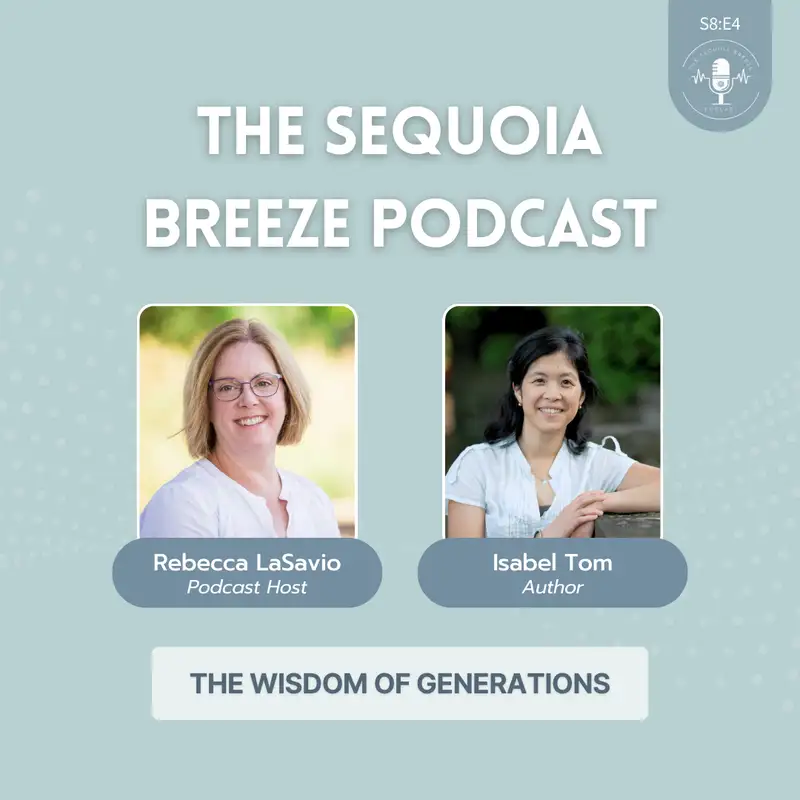
Rebecca: Hello and welcome to the Sequoia Breeze Podcast, a breath of fresh air for your homeschool. I am your host, Rebecca La Savio.
Listeners, I am excited to have a special guest with me today. She is Isabel Tom.
She is the founder of the value of wrinkles.com website and has some really interesting insights to share with us today. So welcome.
Isabel: Hi, Rebecca. Thanks for having me.
My name is Isabel and I'm the author of a book called the Value of Wrinkles, A young perspective on how loving the old will change your life. I also created something called the Grandkid investigator concept or Grandkid Investigator kit.
And really my experience, I grew up in a multi generational household, so I say I'm a retired grandchild.
I'm also a mom of three kids and a wife.
Today is actually my husband and our 16th anniversary, so.
And my background, my professional background has been in senior care and hospice care, end of life care.
Rebecca: Well, congratulations on your anniversary. That's exciting.
Thank you for sharing it with us.
So, Isabel, tell us why you got into obviously living with your own grandparents and helping, I presume, to take care of them and the job that you've done. But why did you decide to start sharing this concept with others?
Isabel: Well, I know that when I graduated from college, I got a job in senior care and I, I didn't expect to enjoy it like I really expected to. I studied business, so I thought, oh, I just got a job and I'm going to transition out of this once I get another job.
But once I started working with a lot of older adults, and I mean, literally within the first week,
I realized, wow, this is a world I don't know anything about. And it is so interesting and it is so fun and I really love the that population.
And then as time went on, I started learning things that I realized, wow, this is helping me live. It was, I was in my 20s and I was like, this is actually helping me live better,
to really cherish, you know, the time that I had. And so it was kind of over time I tell people that I went from being grumpy about having to live with my grandparents to being really grateful for them.
And I can tell you that with each year, like, as I get older and older, I keep reflecting and I realize, wow, that was really good for me.
Rebecca: So your aim is to help parents realize that concentrated intentional time with grandparents is really good for their kids. Is that a fair assessment?
Isabel: Absolutely, absolutely. Just like helping them to eat healthy, diet,
just like making sure that they have, you know, do lots of activities, and they read and get time learning about all different activities and learn, go out in nature, same thing.
I think it's almost. It should be a health.
A trend to try and help your kids to spend more time with the older people around them.
Rebecca: What are a couple of examples of the kinds of things that kiddos learn from the older generation?
Isabel: Oh, so I. I think a lot of it is not necessarily a lot of time times. People say we learn so much, we gain so much wisdom from older people and from grandparents, But I think a lot of it is that kids can learn through just being around them.
So I say one thing is they learn first to relate to people who are different than them.
And when you talk about,
you know, helping your kids to have social skills and how to thrive in this world once they get a first job or go out and try and make friends somewhere, we're trying to help them to relate to people who are different than them.
And who better than somebody who is their grandparent or an older person who is so different?
They're from different generations.
They most likely have been brought up in a completely different environment.
They deal with different things. And so I think when, as a parent, I really try to help other parents to see that we're helping our kids to improve their social skills, improve their ability to work with other people, have relationships with other people who are different than them,
and I would say that's just one reason.
Rebecca: What do you think is the biggest block today for kids getting to know their grandparents? Hmm.
Isabel: So I think the easy answer or the typical answer would be screen time and things like that or a busy schedule.
But I think that one of the biggest challenges is first helping parents to see how important it is,
because parents have so much on their plate,
and so it's hard to. To see that, oh, spending time with their grandparents is the most important thing right now.
So I think it's helping parents to not only see the value of spending time with older adults and with grandparents, but also helping them to learn how to be, I say, the connector or the playmaker in that relationship.
Rebecca: So if kids don't live near their grandparents, are other older adults able to step into that gap with the same benefits?
Isabel: I think, yes, I think that is definitely possible, and I've definitely seen that happen.
I think the one thing is that with family, sometimes you already have a bond created. It might not be a strong bond,
but relationships, as we know, take time. And so when you have a stranger there that you're trying to develop a relationship with, it's harder when the child doesn't know anything about that person.
Or maybe.
Yeah, they might not even feel safe around them yet. Right.
So I think the. The reason why I think we often should focus on that relationship, if possible, with a grandparent is because there's usually already some sort of connection,
and it's easier in that way.
Rebecca: So talk about what a family can do if those grandparents do live far away.
Isabel: Yeah. So I think if distance is an issue, I think first I like to remind families that it doesn't mean that you can't have a close relationship just because you are miles and miles away.
I think what it means is that when you spend time together,
it needs to be very intentional. So for me, I grew up living with my grandparents, and I spent the first 26 years of my life living in the same household as them.
So I kind of,
over time developed an appreciation for them and developed a stronger bond with them because we spent, I say, millions and millions of minutes together.
And you don't get that with the. When you're. When you have grandparents who are long distance. So I think it just means that when you have time together, when you visit them,
that you are really trying to make that time meaningful.
And when you talk to them on the phone,
when you have times where you video chat, you are just trying. You're being more intentional and strategic about the way that you spend your time together.
And that's not always. That's actually sometimes can be a really good thing.
Rebecca: That's one thing I noticed when we lived overseas, we didn't get grandparents on a daily basis like we do now.
But when we did get them, it was.
It was more intentional, it was more intensive, it was more.
We know we only have a little while before they leave again or we leave again. And so we have to make sure that we're sort of getting the most out of every minute.
Where when you live down the street from them, it's a little easier to go into a daily routine.
Isabel: Yeah. And sometimes that can be, I don't want to say dangerous, but sometimes when you live close or live with somebody,
you.
Sometimes you don't. You're not even intentional. And you can literally be in the same room in the same house and not have a close relationship because you don't make that effort to be intentional, to spend time together, to have.
Make memories.
Rebecca: So what is your advice for parents who maybe don't get along with their own parents that well, or grandma and grandpa don't respect some of the ways they want to Raise their kids and those kinds of things.
Isabel: Yeah. So when that, that's definitely something that, that is a reality. Right. We don't all have really close relationships with grandparents and parents.
And I can say when people look at my pictures or look at my upbringing, they think, oh, you all must have just gotten along. And that's wonderful. But that's not how real life happens.
Right. And I think that's one reason why I'm so passionate about providing support and resources to families, because there isn't very much out there about that.
I think I would say first as a parent, we have to process our own feelings.
So anytime, you know,
we have a, there's often baggage between adult children and their parents and a lot of times it may not have been worked out.
And so then a grandchild is born and that can complicate things.
You know,
all, all different sort of conflicts can occur. Right.
And so I think first processing our own feelings. So for example, if you are going to see the grandparents or they are going to come visit and it's stressful, like first stopping and saying, like why is this stressful?
What is it about this interaction that stresses me out? And I think we really have to dig deep and process that because if we're not healthy, like, you know, if we haven't processed that that comes out, we end up creating it.
It, we end up having memories that are not positive memories and it ends up being a very tense time together.
The other thing I would say is that if you don't have a good relationship and your relationship is strained with an a parent or in laws,
maybe first starting and doing things that maybe aren't like one week vacation together, you know, knowing that you can,
you can show your kids that the grandparents are important, you can help them have a relationship. But it doesn't always have to look a certain way.
It can start with just maybe letters,
sending cards. Right. That doesn't require you to have live response right there. Or maybe instead of having a phone call or a video chat, you can just have them send videos.
Right. Like we love you or one thing we appreciate about you is this and sending a video because it's true. I mean, relationships are complicated and I don't think we have, I think we need to remember and have a realistic expectation of that relationship and also realizing that if,
if it's not healthy, you know, you don't need to force,
force that relationship. But there are different ways to honor parents, to honor in laws that don't require spending a lot of quality time together. Just like the five love languages, there are different ways to love.
Rebecca: So let's jump into the Grandkid Investigator Kit from there, because I suspect that's one of those ways that you have some tools in there for learning about and respecting grandparents without necessarily spending intensive time together.
That might be difficult.
Isabel: Yes, absolutely.
So I can tell you, I. I created this because I realized that parents need help when they are interacting with the parents. And again,
sometimes there are topics that adult children, they're like, I don't want to talk about this with my parents,
and I don't want to be around them because this is causing. I don't want this topic to come up.
So instead, the Grandkid Investigator kit, there are 12 missions, and they cover a whole number of different topics that you typically wouldn't think of when you're having conversation. Right. And so I really wanted to give a chance for kids to use, I say, their superpower to help them to develop a curiosity about their grandparents and to learn about them,
to investigate about them and to be able to pull out shorter stories.
So one thing in working with older adults is, and grandparents especially, they want to leave a legacy. The problem is that sometimes their legacy, oh, oftentimes their legacy,
it always spans decades.
And so that story that they want to share or that legacy they want to share is maybe like 10 hours long or maybe it's like a couple volumes of, you know,
thick, thick books. And these kids, their grandkids are not that they don't care, but they don't have the attention span to be able to handle it.
And so this allows a grandparent to feel seen and heard,
but it pulls out those short, little fun facts that I know My kids are 8, 10, and 13,
and I know my boys especially, they love those fun facts, those weird but true facts, those Guinness Book of World Record facts. And so there are a whole number of missions that we parents can task or grandparents can task their kids to do to learn more about the grandparents.
Rebecca: It also seems like a great opportunity as homeschoolers. I know my kids have done a couple of,
you're learning about the Vietnam War, go call grandpa and find out.
Isabel: Yes.
Rebecca: What that was like for him. Or they are fortunate enough to even still have some great grandparents alive so they can go further back if they want and yeah, ask some questions of.
Of further back times.
And I think, don't forget, as we're teaching history parents, that we have living history right there with us and being able to find out what things were like at a different time.
Period from that person. Because sometimes I know I have had impressions of periods in history from books and media that when I've talked to my parents about it, they're like, I mean, it was happening, but it.
Not really for us, you know. Didn't you like. Yeah, it wasn't quite as all encompassing. So we are sometimes made to think or whatever.
Isabel: Yeah. And I would like to add, actually a lot of homeschooling parents, maybe they have. They might have kids who are neurodivergent. And I know that, you know, learning,
it does not have to happen. And it can be difficult for some children just reading it out of a book. So this is a perfect, perfect way for kids to learn and to, I think, connect.
Like, just to have a visual and have a person and then to hear those stories is such a better way to learn. I know. Even my kids, when they've done grandkid investigator missions, it's like they asked my grand.
My mom,
did you have a stove when you were younger? And my mom's like, no, I didn't have a stove. I had a tin can with wood underneath. And it's like, that's how we cooked stuff, you know?
And I just. I love it when I hear my kids telling me those stories again,
because I'm like, they learned that. And not only did they learn that they appreciated their grandma because they were listening to her, and she appreciates that. So it's like so much more than just the learning.
It's about creating, you know, creating a stronger bond. And I think when.
When the. Our parents see our kids interested, that is,
that's one way, number one, to help them to see that homeschooling can be very valuable. Right. And it honors them. And I think they're like, oh, wow, you know, you know, somebody's interested in me now.
So I really. I really love it when I see that happen.
Rebecca: Sometimes kids, favorite stories from older people are the ways that the older people were naughty when they were little too.
Isabel: Yes. Oh, I didn't invent about their parents,
about their parent. Yeah. My. My kids asked my mom, what did you do when. Cried a lot. Because I did cry a lot when I was little.
So it's like hearing those stories. They love that. Right. And that's just.
I mean, I think it's just fun for older people to be able to reminisce about those times as well.
And, you know, aging is hard. And so to have them to have. When they have a chance to talk about something else besides their health concerns or,
you know,
to. To focus so much on how their body may not be feeling. Well, I think it is really a great mood booster for them. Like, it improves their quality of life.
Rebecca: Do you think all of this value is there if the grandparents are young? Some. There are, you know, some grandparents are in their early 50s and they have.
Isabel: You know, they might already.
I do, but it may be diff. A little different. Right. So I think if the grandparents are young, they're able to do more things with them.
So the problem with older grandparents is sometimes they're not able to, let's say, go on a hike or,
you know, do as many active activities together. So I think if the grandparents are younger, you get to. You. They probably get to enjoy the same activities as the kids enjoy sometimes.
But I think the other thing too is no matter how old they are, no matter how active they are,
our kids are getting, I say they get an extra layer of love and attention that helps build this resiliency for life. So just having another adult that like,
showers love on them is so valuable for our kids, whether they are 80 or 50. Right. Like,
I think either way, it's. It's valuable to our kids.
Rebecca: Talk for a minute about.
I'm assuming that you have come across this and maybe even experienced it yourself, but talk a little bit about the.
The value or the tricky pieces of having grandparents that are maybe were immigrants or the kids have left. So one of the things we saw when we were overseas as is that there were younger families that had moved to America and the grandkids all spoke English and had a difficult time communicating with grandparents.
And that always made me really sad.
How can families sort of.
I mean, you've got worldview differences. You've got. You just. There's a lot packed into a family that's dealing with either grandparents overseas are living with them, but speaking a different language and having different expectations about culture and all of those things.
Isabel: Yes. I mean, it gets very complicated. And that's why sometimes I'm like, this is for the counselor. This is not a question for me, but.
But I think it adds, you know, my grandparents, they came over to the US later in life, and I am. I was born in the U.S. so we, you know, there's.
I definitely experience. Experienced that, and I know others who have experienced that as well.
I think it just means, you know, you have two different languages, whether it is, you know, a barrier, like an actual language barrier. My grandparents spoke Cantonese, they spoke Chinese, and I spoke English, but I also spoke a tiny bit of Cantonese and So there was a language barrier.
But anytime you have generations and diff, you have differences. And so it is still. You do have a language gap.
And so I think it just takes creativity. It takes being intentional.
It takes. It. It was really valuable having that connector, so having that parent who understands at least a little more of each side to translate. And,
you know,
your listeners can't see my actions, what I'm doing, but they are able to translate.
Not an actual language, but they're able to help connect the. Those two generations and maybe explain things. Like I might explain to my parent that, oh, yeah, kids nowadays, this is what they're dealing with.
And to help my parents to understand more of their grandchild's life, and then I might have to help the child. My kids understand,
you know,
you know, mama or paw paw, which is what. How you say grandma in Chinese. Like they, you know, growing up, they didn't have a lot. And so that's why when they see you do this, it really triggers them, you know, they may say something.
And so I think it's just so valuable just to talk as a parent and explain these things to our kids so that they don't have bitter feelings towards the older generation and then vice versa.
Rebecca: Yeah, that's really helpful because there can be translating going on, no matter exactly what's going on.
Isabel: Yeah.
Rebecca: But I do think,
I think sometimes when immigrant families are involved, you can get real caught up in trying to either be American and leave the old stuff behind, or you're just so busy trying to keep everything together that some of those details and what that can all feel like the old stuff we've left.
Isabel: We aren't.
Rebecca: We aren't necessarily wanting to value those things anymore, but I. I think we can still remember to value the people.
Isabel: Yeah. There's a lot of pressure, I would say, for the younger generation to try and please the older generation with the way that they live their lives.
And. But then it. It's. It's complicated. Right.
I think that could be a whole nother podcast topic.
Rebecca: Fair enough.
How do you help kiddos want to do this? To have a good attitude about whether, you know, not seeing the grandparent kit as,
Sorry, the grandparent investigator kit as an assignment, but something that's really fun,
or when they know that they've gotta speak really loudly so grandma can hear them, or they need to be patient and,
you know, sit through whatever. How do you help them have a good attitude about these interactions?
Isabel: Okay, so the first thing I like to tell parents is that it's Kind of like helping your kids appreciate and connect with their grandparents and bless them and honor them. It is kind of like getting them to eat veggies,
making them practice piano.
All of those types of things I say, you know, having, for me, having to go to Chinese school when I was younger, these are things that are good for them, but they might not always appreciate them.
And so it, at least as a parent, to remember to keep going,
knowing that there is value to this. Right.
I think with the kids, especially when they're younger and even when they're older, as teens and young adults too, I like to remind kids,
help them to realize that they have this superpower to be able to bless the older generation through very simple gestures. Like, I can say hello to the older lady down the street, our neighbor,
and she might look at me and say, hmm, good morning.
And my daughter or my son, if they say good morning,
you just watch. It's. It's. Do an experiment. They light up. Because the fact that a younger person acknowledged them means so much these days.
And so I used to, when I would go to the nursing home with my kids when they were younger, I would just tell my kids, you know, when you say hi, all you need to say is hi.
And just watch. They're gonna love you. They're just gonna. Or all you have to do is wave and you are going to just make their day. And it is so true.
You know, just look at if a grandchild or a younger person goes to help an older person with their bags.
I remember one lady, she said, at church, there are these young men who always come to me and help me carry my bags in every Sunday. And she was just beaming.
The fact that they did that right, and the. All it did was it was probably like 20 seconds of their time.
Yet through those simple gestures, they were able to bless her immensely and really help her to see. Wow. Like,
they see me, you know, I'm very special.
So I. I think partly is when we see our kids do things to really praise them and encourage them and say, did you see that? You know, that really made your grandpa happy, just the fact that you asked him how his day went.
Or did you see when you called her,
all you did was call her. And she, you know, grandma loved it. She was just. She was probably very shocked to hear from you because she knows you're busy.
So I, I really think it's important to explain things to our kids and help them to see what. That what they're doing is valuable and powerful.
Rebecca: That is an excellent point. It's something that again, when we lived overseas and we walked everywhere, you'd see more people. And I sometimes forget to tell my kids this today,
but I remember having conversations with them about, hey,
when you say hello to one of those older people, when you answer them, they feel special.
When kids talk to grownups, they feel special. And I remember I have seen surprise on every one of my kiddos faces when I've explained that to them. They don't imagine that they could make a grownup feel special.
That's, that's news to them.
And it also takes them out of their own head. It helps them get out of like, I don't feel comfortable with this. Well, that's okay because you've just done something nice for somebody else and it takes them kind of out of their own place.
And I think I'm going to share my own personal opinion.
Isabel: Sure.
Rebecca: Sometimes we let, we let kids sort of live,
let their discomfort rule them a little too often and it's, it's okay for them to do something they feel uncomfortable with for the benefit of somebody else. And so that is.
But kids do not understand inherently that they can encourage somebody else and make that they will make them feel special. That is, they are really surprised that they have that power over a grownup.
Isabel: And I think that the other thing to realize too is that kids want to make difference or teens want to make a difference, young people want to make difference. And that's always why they're thinking, like, one day I want to do this,
but to help them to realize, like right now,
when you do this, like, you don't have to have a driver's license, you don't have to graduate from high school, you don't have to go to an Ivy League to make this really big difference in the life of somebody very close to you.
You know, they don't have to do very much. And I think that can be very empowering for kids who,
especially if they don't,
maybe they're not very good or they don't get recognition for being like the top in their class or the most beautiful or things like that. I think it can be very empowering.
Rebecca: So tell us a little bit more about some of the, you know, you have resources available.
You've mentioned the Grandkid Investigator Kit. Where can they, where can families find that?
Isabel: So you can go to valueofwrinkles.com GKI so that's GKI to check out the Grandkid Investigator Kit. And you can go to my website, valueofwinkles.com to check out all the other things too as well.
Would you like me to tell you about my book or some of the other things?
Rebecca: Your book. And I actually listened to a couple of your of podcasts you did with other people, but I didn't.
It's your podcast, so I just realized that you have that as well. So tell us about both of those things.
Isabel: Sure. So I have the Value of Wrinkles podcast and I created that because I wanted other people to see like the wonderful things about older adults and also just to gain a little bit of different perspective in a fresh way.
And all of those episodes are short and so they're very helpful for parents, I would say, who are on the go. And then I also wrote a book called the Value of Wrinkles, A young perspective on how loving the old will change your life.
I'll say. It's an easy read,
a lot of stories in it. Somebody just sent me a picture of an eight year old reading it. So although that was not my target audience,
I've had young people all the way to like people who are around a hundred reading it. So I think it can just be an encouragement and a practical guide for people,
people of all ages.
Rebecca: Isabel, thank you so much for being here today. Do you have any, is there anything we didn't cover that you want to say before we go?
Isabel: I think it's just to.
Just to keep pressing on and to finding ways. I want to encourage parents to find ways to be intentional in creating those relationships with the grandparents or other older adults.
And the reason is because there's an urgency. Our older loved ones aren't going to be here.
We don't know how much time we have left with them.
And so there is an urgency to it. It's not just something,
you know, like a fun activity.
Other things, they, they can wait. But our older loved ones, we don't know how much time we have with left with them.
Rebecca: It's an uncomfortable but very true thought.
Isabel: Yeah, it is.
Rebecca: Well, thank you so much for being here. I really appreciate you sharing your anniversary day with us.
Isabel: Thank you. Thank you. Have a great day. All right, thanks, Rebecca.
Rebecca: Listeners, I hope you've been encouraged today by this thought provoking topic. What changes will you make after hearing from Isabel today about all of the important benefits of facilitating time spent between our kiddos and our parents or other older relatives?
I would love to hear all about it at podcasts@sequoiagrove.org as the holidays approach, we have a great opportunity to get started on this now I also want to let you know that the valueofwrinkles.com is a vendor with our schools and so you can order a Grandparent Investigator Kit with school funds and create a great project for your students.
Thank you for joining me today on the Sequoia Breeze Podcast, a breath of fresh air for your homeschool. I've been your host,
Rebecca La Savio. I hope that you will share this episode with somebody that you think could be encouraged by it.
And as always,
like and subscribe. Leave us a Review it's really helpful to others who want to find us.